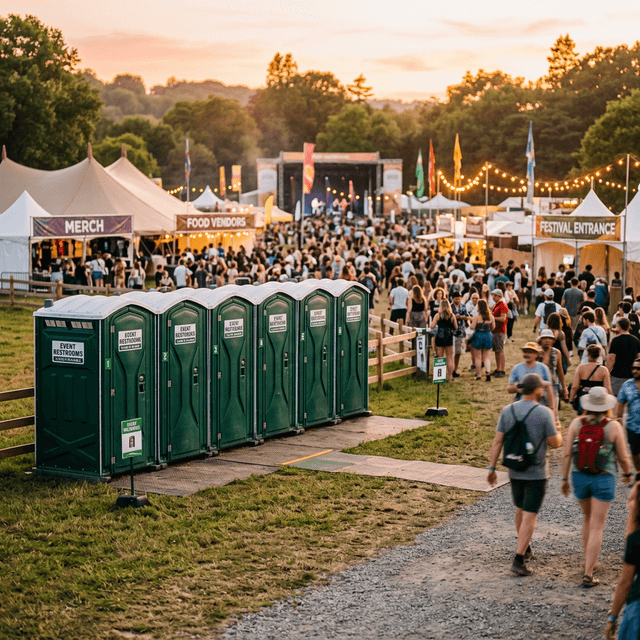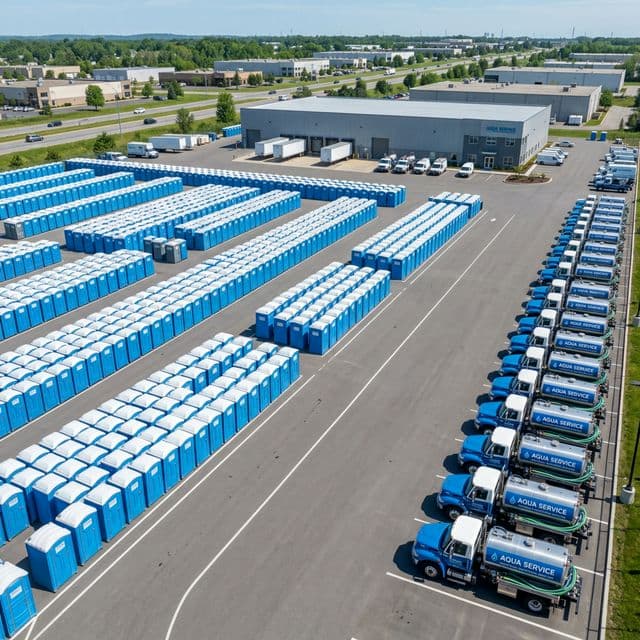
Standard construction site units need pumping once per week for up to 10 regular users. High-demand events require daily or twice-daily service. The key variable is tank capacity (60 gallons standard) vs. daily usage volume (approximately 6 gallons per 10 users per day).
Servicing Fundamentals
A standard portable toilet has a 60-gallon waste tank. At average usage rates, this tank reaches the recommended 75% capacity threshold after approximately 50 individual uses, which translates to 10 users over 5 work days.
Servicing is the backbone of the portable toilet rental business. Get it right, and clients renew their contracts month after month. Get it wrong, and you get angry phone calls, health department complaints, and lost accounts.
Construction Site Servicing
The standard schedule for construction sites is once per week for up to 10 regular users per unit.
| Users Per Unit | Service Frequency |
|---|---|
| 1 - 10 | Weekly |
| 11 - 20 | Twice weekly |
| 21 - 30 | Three times weekly |
| 30+ | Daily or split into additional units |
The 75% rule: Never let a tank exceed 75% capacity. Beyond this point, odor becomes noticeable, splash risk increases, and user complaints spike. Schedule service to arrive before the tank hits this threshold, not after.
What service includes:
- Pump out the entire waste tank using a vacuum truck.
- Rinse the tank interior with clean water.
- Refill the tank with fresh water and blue deodorizing chemical.
- Clean all interior surfaces: walls, seat, floor, urinal.
- Restock toilet paper and hand sanitizer.
- Inspect the unit for damage and log the service via QR code.
Event Servicing Schedules
Events require dramatically more frequent service because usage is concentrated into short time periods:
| Event Type | Duration | Service Frequency |
|---|---|---|
| Wedding (150 guests) | 4-6 hours | Pre-event setup only |
| Corporate outdoor event | 4-8 hours | Once during event |
| Music festival (1 day) | 8-12 hours | Every 6-8 hours |
| Multi-day festival | 2-3 days | Every 6-8 hours + overnight |
For multi-day festivals, position your service trucks on-site for the duration. Off-site staging adds transit time, making it impossible to maintain frequency during peak periods.
Deodorizing Chemicals and Treatments
The blue liquid in a portable toilet is a combination of biocide, fragrance, and dye. Never use formaldehyde-based chemicals. They are banned in many jurisdictions and harmful to wastewater treatment plants.
- -Standard formaldehyde-free treatment for regular conditions ($3-$5/unit).
- -High-temp summer formula for temperatures above 90F ($5-$8/unit).
- -Eco-friendly biodegradable for green events ($6-$10/unit).
The Real Math Behind Pumping Frequency
Temperature is the biggest factor that published guidelines ignore. In summer heat (above 90°F), waste decomposition accelerates and produces significantly more odor and gas pressure. Units at outdoor events in July should be serviced every 3-4 days rather than weekly.
"Operators who track usage data over time can fine-tune their routes and pricing. If Site A consistently needs service every 5 days instead of 7, adjust the schedule proactively rather than responding to emergency overflow calls."
Servicing Frequency by Deployment Type
The optimal pumping and cleaning schedule varies dramatically based on the type of deployment, the number of users, and the environmental conditions. Under-servicing leads to health code violations and lost contracts. Over-servicing wastes fuel and labor.
Construction sites with up to 10 workers per unit require weekly servicing at minimum. Events with high-traffic units may require twice-daily servicing during the event. Long-term residential construction with a single unit requires bi-weekly servicing. Remote sites in extreme heat conditions require twice-weekly servicing due to accelerated decomposition and odor generation.
The CDC (Centers for Disease Control and Prevention) recommends that portable sanitation facilities be serviced before waste tanks reach 75% capacity to prevent overflow, odor, and vector attraction.
Field Technician Servicing Checklist
Every servicing visit must follow a standardized protocol to ensure compliance, prevent callbacks, and protect the operator's reputation:
- Tank Pumping: Vacuum the holding tank completely. Partial pumping is unacceptable and leads to rapid re-accumulation.
- Interior Cleaning: Wipe all surfaces including the seat, walls, floor, and door handle with EPA-approved disinfectant.
- Chemical Recharge: Add the correct volume of holding tank chemical based on the tank capacity and expected usage until next service.
- Supply Replenishment: Refill toilet paper, hand sanitizer, and paper towels. Empty supply dispensers are the number one complaint from end users.
- Exterior Inspection: Check for structural damage, graffiti, and secure door latching. Report any damage to dispatch immediately with photos.
For more on health compliance, read our guide on Health Department Inspection for Portable Toilets.
Automated Servicing Schedule Optimization
The transition from calendar-based to usage-based servicing schedules requires a software platform capable of tracking real-time unit conditions and predicting when each unit will require its next service visit. Static weekly schedules waste resources by servicing lightly-used construction site units at the same frequency as high-traffic event units. Intelligent scheduling algorithms analyze historical usage patterns for each deployed unit and dynamically adjust the servicing frequency to match actual demand. A unit deployed at a 5-person residential construction site may only need biweekly servicing, while a unit at a busy commercial site with 50 workers requires twice-weekly attention. This optimization reduces total fleet servicing costs by 15-25% while actually improving customer satisfaction through more precise service delivery.
Technician Efficiency Optimization for Servicing Routes
The profitability of a portable toilet servicing operation is determined by the number of units a single technician can service per shift. Industry averages range from twelve to eighteen units per eight-hour shift depending on geographic density, drive times between stops, and the condition of units at each location.
Optimizing technician efficiency starts with route sequencing that minimizes windshield time between stops. A pump truck traveling between construction sites scattered across a forty-mile service radius will service fewer units per day than the same truck working a dense cluster of event units within a five-mile radius. The dispatch platform should group servicing stops by geographic cluster and assign each cluster to the nearest available truck rather than distributing stops randomly across the fleet.
The second optimization lever is reducing time-on-site per unit. Experienced technicians who follow a standardized servicing checklist complete each unit in eight to twelve minutes. Inexperienced technicians or those without a structured process can take fifteen to twenty minutes per unit. The three-to-eight minute difference per stop compounds across a full day of servicing, representing the difference between servicing fourteen units and servicing eighteen units per shift. Standardized training programs that drill the pump-clean-restock sequence until it becomes automatic are one of the highest-ROI investments a portable sanitation operator can make.
Chemical Degradation Modeling in Portable Sanitation
The primary objective of a servicing schedule is not merely the removal of waste; it is the active management of the biological environment within the holding tank. A portable toilet is essentially a controlled anaerobic digestion system, and the speed at which that system degrades is governed by complex chemical and environmental factors. Relying on a rigid, static servicing schedule—such as "every Wednesday, regardless of conditions"—guarantees that a significant portion of the fleet will be either over-serviced (wasting labor) or under-serviced (creating severe odor issues).
The active ingredient in most portable toilet deodorizers is a biocide, often a quaternary ammonium compound, designed to inhibit the growth of odor-producing bacteria. However, the efficacy of this biocide is not infinite. Its degradation curve is exponential, heavily influenced by ambient temperature and the cumulative volume of introduced organic matter. At seventy degrees Fahrenheit, a standard chemical dose may suppress bacterial growth effectively for seven days. At ninety-five degrees Fahrenheit, the accelerated biological activity can overwhelm the same chemical dose in under forty-eight hours.
Advanced fleet management platforms integrate chemical degradation modeling into their dispatch algorithms. By pulling hyper-local meteorological data via API, the system calculates a real-time "thermal stress index" for every deployed unit in the field. During a prolonged heatwave, the algorithm automatically compresses the servicing intervals for units in direct sunlight, generating proactive work orders to pump and recharge the tanks before the biological breakdown creates an odor crisis that prompts a customer complaint.
This predictive approach extends to usage density as well. A unit on a residential construction site with three workers will degrade much slower than a unit on a commercial site with twenty workers, even under identical thermal conditions. By analyzing the historical pump-out volumes for each specific site, the software builds a customized degradation model for every active contract, dynamically adjusting the required service frequency to maintain the optimal chemical balance within the tank at the lowest possible operational cost.
Algorithmic Route Density Optimization
The profitability of a portable sanitation enterprise is won or lost in the routing of the pump trucks. Fuel and labor are the two largest variable expenses on the P&L statement, and both are directly correlated to the number of miles driven between service stops. A poorly routed truck burning diesel while crisscrossing a metropolitan area is literally incinerating the company's profit margin.
The mathematical complexity of optimizing a service route containing fifty stops across varied terrain, accounting for traffic patterns and specific customer time windows, is an NP-hard problem that far exceeds human cognitive ability. Traditional dispatchers inevitably rely on geographic heuristics, grouping stops by zip code or neighborhood. While better than random routing, this approach still leaves massive inefficiencies unaddressed.
Modern algorithmic dispatch platforms solve the Traveling Salesperson Problem (TSP) using advanced computational heuristics. The software ingests the entire required service manifest for the day and runs millions of permutations in seconds to identify the absolute shortest, most time-efficient path. Crucially, the algorithm also factors in the pump truck's holding capacity. It ensures that the truck services high-volume stops (like large commercial sites) early in the route before the vacuum tank reaches its weight limit, preventing the costly necessity of an mid-shift trip to the disposal facility.
The financial impact of algorithmic route density optimization is transformative. Operators transitioning from manual routing to software-driven optimization consistently document a fifteen to twenty percent reduction in total daily mileage. For a ten-truck fleet, this efficiency gain translates directly to tens of thousands of dollars in annual fuel savings, reduced vehicle depreciation, and the ability to service more units per day without increasing labor costs or hiring additional drivers.
The continuous monitoring of fluid dynamics within the holding tank provides a critical leading indicator of potential structural failure. If the sensors detect an unexpected drop in fluid volume between service visits, the system can instantly flag the unit for a potential leak or crack in the polyethylene casing. This allows the operator to dispatch a maintenance vehicle to swap the damaged unit before the leaking waste causes significant environmental contamination or triggers a municipal citation.
The algorithmic optimization of servicing schedules maximizes the profit margin of every route. By dynamically adjusting service frequency based on predictive models, the operator ensures exceptional facility hygiene while mathematically minimizing the associated fuel and labor expenditures.
The implementation of dynamic servicing schedules requires a fundamental shift in how operators compensate their drivers. Traditionally, drivers are paid a daily rate or an hourly wage based on a static, predictable route. When an algorithm begins optimizing routes daily—causing a driver's geographic territory and stop count to fluctuate based on thermal stress and usage density models—the traditional compensation structures fail. Operators must transition to performance-based or piece-rate compensation models, where drivers are paid a base rate plus a variable bonus tied directly to the number of units successfully serviced and the quality of the service (verified by the required digital photographs). This aligns the driver's financial incentives with the algorithm's efficiency goals, ensuring that the theoretical gains generated by the software are actually realized on the ground by a motivated workforce.
The environmental compliance dimension of pumping schedules intersects with EPA wastewater regulations that vary by jurisdiction. In many municipalities, grease and chemical concentrations in portable toilet waste must fall within specific limits for acceptance at the wastewater treatment facility. Servicing schedules that allow waste to remain in tanks for extended periods can alter the chemical composition through decomposition processes that may push concentrations outside acceptable ranges. Regular pumping maintains waste chemistry within treatment facility acceptance parameters.
The most sophisticated portable sanitation operators are beginning to deploy IoT sensors inside holding tanks that measure fill levels in real time. These sensors transmit data to the dispatch platform, enabling truly usage-based servicing schedules that eliminate both over-servicing waste and under-servicing risk. While the sensor technology adds $50-$80 per unit in hardware costs, the operational savings from optimized servicing routes more than justify the investment for operators managing 100 or more deployed units.
Keep reading: