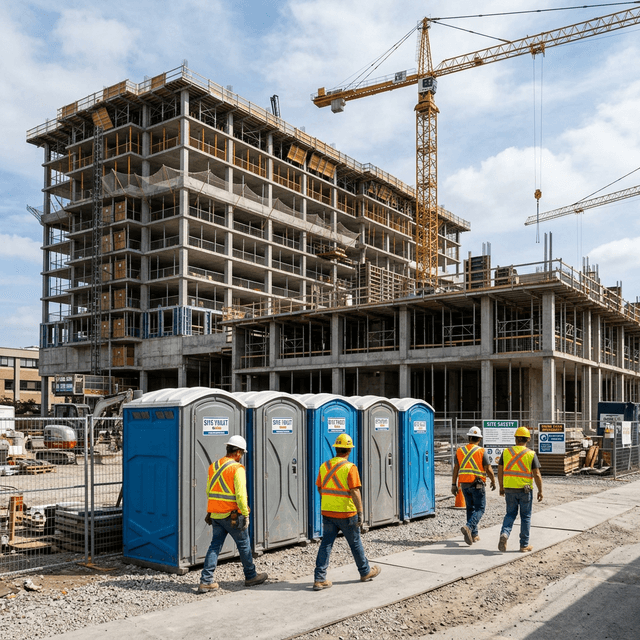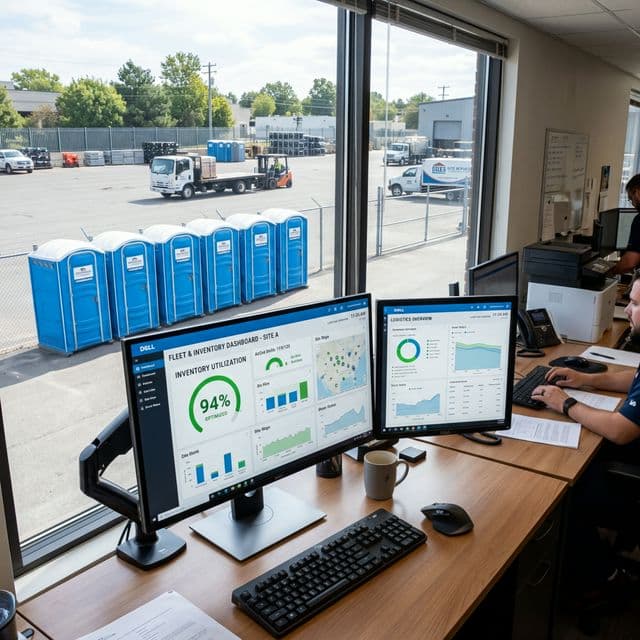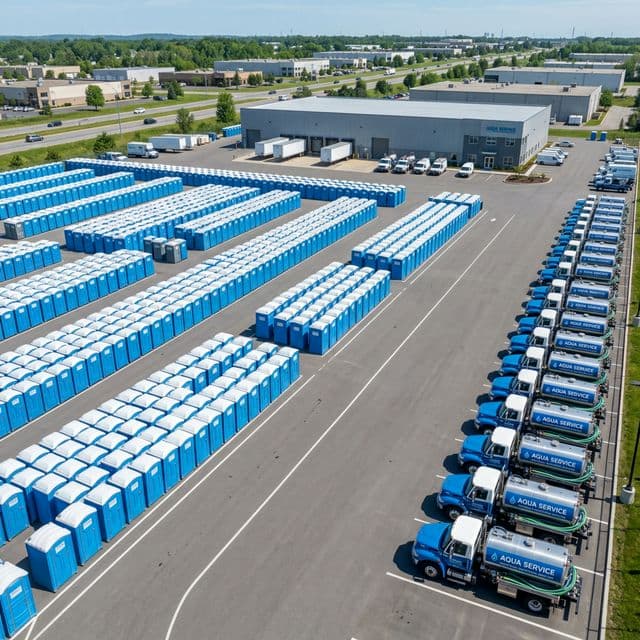
A portable toilet unit has a usable lifespan of 8-12 years with proper maintenance. Fleet management is about tracking three things: where every unit is, what condition it is in, and when it needs to be replaced. Operators who track these systematically reduce unit downtime by 40%.
Fleet Management Fundamentals
The average portable toilet rental company has a fleet utilization rate of 65%, meaning 35% of their units sit idle at any given time. Top operators achieve 80-85% utilization through better inventory tracking and demand forecasting, generating 25-30% more revenue from the same asset base.
Your fleet is your business. Every unit sitting in the yard is a depreciating asset generating zero revenue. Every unit on a job site is revenue. Fleet management is the discipline of maximizing the ratio of deployed units to total units while keeping every unit in servable condition.
For operators with fewer than 50 units, a spreadsheet works. Beyond 50 units, you need a dedicated tracking system.
Inventory Tracking System
Every unit in your fleet needs a unique identifier and a status:
| Status | Definition |
|---|---|
| Deployed | On a job site, generating revenue |
| Available | In the yard, clean, ready for deployment |
| In Service | Being pumped, cleaned, or repaired |
| Damaged | Requires repair before deployment |
| Retired | End of life, pending disposal or sale |
Tag each unit with a weatherproof asset label (QR code or barcode). When the service technician pumps a unit, they scan the tag. This automatically updates the system with the service date, location, and condition notes.
The lost unit problem: Every fleet operator has units they cannot account for. They were delivered to a site, the contract ended, and nobody picked them up. Asset tracking with QR codes and GPS-enabled delivery confirmations eliminates this problem. A single lost unit costs $500-$1,000 in asset value plus the lost rental revenue.
Preventive Maintenance Schedule
- Weekly: Service (pump, clean, restock) during regular route visits.
- Monthly: Inspect door latches, hinges, ventilation pipe, and floor integrity.
- Quarterly: Deep clean interior and exterior. Pressure wash if needed. Check for stress cracks.
- Annually: Full structural inspection. Replace worn door springs, floor mats, and seat assemblies.
- As needed: Repair cracks, replace broken latches, address graffiti or vandalism damage.
Preventing maintenance is cheaper than reactive maintenance. A $15 door spring replaced proactively avoids the $75 emergency repair call when the door breaks on a Friday afternoon at a job site.
Depreciation and Replacement Planning
Standard portable toilet units depreciate over 7-10 years for tax purposes. The actual usable life depends on maintenance quality:
- -Well-maintained units: 10-12 year lifespan
- -Average maintenance: 7-9 year lifespan
- -Heavy use (events, high-demand sites): 5-7 year lifespan
- -Luxury trailers: 15-20 year lifespan with regular refurbishment
Replacement planning rule: Budget for replacing 10-15% of your fleet annually. If you have 100 units, plan to purchase 10-15 new units each year and retire the oldest or most damaged units.
"Retired units still have value. Sell them to smaller operators, export markets, or scrap the plastic shell for recycling credit ($25-$50 per unit)."
Scaling Your Fleet
The most common scaling mistake is buying too many units too fast. New units sitting idle cost money (storage, insurance, depreciation). Scale your fleet in response to confirmed demand: when utilization exceeds 80% for 3 consecutive months, it is time to add units. Use modern AI routing to maximize fleet deployment dynamically.
Fleet Cost Analysis by Vehicle Type
Understanding the total cost of operating each vehicle class in a portable sanitation fleet is essential for maximizing route profitability and making informed capital expenditure decisions.
Flatbed trucks carrying 8-12 standard units typically cost $1.10 per mile loaded and are ideal for multi-stop construction site delivery routes. Vacuum/pump trucks for servicing operations cost $1.85 per mile due to higher fuel consumption and specialized maintenance. Light-duty pickup trucks for single-unit emergency deliveries cost $0.65 per mile, making them the most cost-effective option for rapid response.
The Department of Transportation (DOT) requires commercial driver's licenses for vehicles exceeding specific weight thresholds, adding insurance and compliance costs that must be factored into fleet economics.
Preventive Maintenance Schedule
A proactive maintenance schedule prevents the catastrophic scenario of a delivery truck breaking down while loaded with units en route to a festival or construction site:
- Daily Pre-Trip Inspection: Tire pressure, fluid levels, and hydraulic lift functionality check before the first route of the day.
- Weekly Deep Inspection: Brake system, suspension, and cargo tie-down integrity assessment by a qualified mechanic.
- Monthly Pump Truck Servicing: Vacuum pump inspection, hose integrity check, and tank cleaning for all pump/service trucks.
- Quarterly DOT Compliance: Full vehicle inspection against DOT requirements, including lighting, mirrors, and frame integrity.
- Annual Overhaul: Complete engine, transmission, and hydraulic system assessment with replacement of wear components.
For more on inventory management, read our guide on Tracking Portable Toilet Inventory Utilization.
Fleet Analytics and Decision Making
Data-driven fleet management transforms portable toilet operations from a reactive business into a strategic enterprise. By tracking utilization rates per vehicle, revenue per route, and cost per delivery across the entire fleet, operators can identify which vehicles are generating profit and which are destroying margin. The analytics dashboard reveals patterns that are invisible to the human eye: a specific truck that consistently burns 30% more fuel than identical vehicles in the fleet due to a mechanical issue, a route that appears profitable but actually loses money when return-trip deadheading costs are included, or a technician whose servicing speed is 40% slower than the team average due to an inefficient pumping technique. Each of these insights translates directly into actionable cost reduction and revenue optimization.
Fleet Replacement Planning and Capital Budgeting
Successful fleet management requires a forward-looking capital expenditure plan that replaces aging units before they become maintenance liabilities. The replacement decision for portable toilets involves balancing the declining revenue potential of aging units against the capital cost of new inventory.
A standard polyethylene portable toilet unit has an economic useful life of ten to fifteen years depending on climate exposure, usage intensity, and maintenance quality. Units deployed year-round in southern climates with high UV exposure degrade faster than units in northern markets that spend winter months in storage. The operator should maintain a fleet age spreadsheet that tracks each unit's purchase date, deployment history, cumulative maintenance costs, and current condition score.
The optimal replacement trigger combines age, condition, and financial metrics. When a unit's annual maintenance costs exceed thirty-five percent of its annual rental revenue, replacement is financially justified regardless of age. When a unit's condition score drops below three on a five-point scale for three consecutive service visits, replacement is operationally necessary to maintain customer satisfaction. When a unit reaches twelve years of age, it should be placed on a watch list for replacement within the next budget cycle even if current condition is acceptable.
Predictive Maintenance Through Advanced Telematics
The traditional approach to pump truck maintenance in the portable sanitation industry is strictly reactive: a vehicle is driven until a component fails, at which point it is towed to a mechanic, resulting in thousands of dollars in repair costs and days of lost revenue. Advanced fleet management platforms replace this costly cycle with predictive maintenance driven by deep hardware telematics integration, transforming maintenance from a sudden crisis into a scheduled, budgeted event.
Modern telematics systems go far beyond basic GPS dot-on-a-map tracking. They connect directly to the vehicle's On-Board Diagnostics (OBD-II) port and Heavy-Duty (J1939) datalinks, pulling real-time engine telemetry into the centralized dispatch software. This data stream monitors critical parameters including engine coolant temperature, oil pressure, transmission fluid life, and diesel particulate filter (DPF) status.
When the dispatch software detects that a truck's DPF soot levels are approaching critical thresholds, it does not wait for a dashboard warning light to alert the driver. Instead, the AI automatically flags the vehicle in the maintenance dashboard and proactively adjusts the routing algorithm for that specific truck the following day, ensuring it is assigned to highway routes that generate sufficient exhaust heat to trigger an active regeneration cycle, thereby preventing a costly forced regeneration at the dealership.
Furthermore, specialized sensors can monitor the auxiliary equipment that is unique to the sanitation industry, such as the Power Take-Off (PTO) unit and the vacuum pump itself. By tracking the exact number of hours the PTO is engaged—rather than just the vehicle's overall mileage—the fleet manager can schedule vacuum pump vane replacements and oil changes based on actual operational wear. This granular, sensor-driven data allows the operator to maximize the useful life of every consumable component while virtually eliminating catastrophic on-route breakdowns that destroy customer trust and daily profitability.
Route Density Optimization and Fuel Economics
Fuel expense is consistently the second highest operational cost for a portable sanitation fleet, trailing only labor. However, fuel costs are not static; they are highly volatile and directly tied to route efficiency. Fleet management is fundamentally an exercise in maximizing route density—servicing the maximum number of units over the minimum number of driven miles.
The mathematical complexity of route density optimization exceeds human cognitive capacity once a fleet grows beyond three or four trucks. A human dispatcher attempting to sequence fifty service stops across a sprawling metropolitan area will inevitably create overlapping routes, inefficient backtracking, and excessive "windshield time."
Advanced fleet management algorithms solve this through dynamic spatial clustering and Traveling Salesperson Problem (TSP) optimization. The software ingests all required service stops for the day and groups them into dense geographic clusters. It then calculates the optimal path through each cluster, accounting for variables such as one-way streets, historic traffic patterns at specific times of day, and the weight capacity of the pump truck (ensuring the truck visits heavy-volume event units early in the route before the waste tank is full).
The economic impact of this algorithmic routing is staggering. Moving from manual routing to algorithmic optimization typically yields a fifteen to twenty-five percent reduction in total daily mileage. For a ten-truck fleet averaging one hundred miles per day per truck at six miles per gallon, a twenty percent efficiency gain saves roughly eight hundred gallons of diesel per month. At four dollars per gallon, that represents over thirty-eight thousand dollars in pure bottom-line profit annually—generated entirely by intelligent software eliminating wasted miles. Additionally, this reduced mileage drastically lowers vehicle depreciation and extends the intervals between costly tire replacements and brake jobs, compounding the financial benefit across the entire fleet lifecycle.
Furthermore, the integration of advanced diagnostic trouble code (DTC) monitoring allows the system to differentiate between critical mechanical failures that require immediate towing and minor sensor errors that can be safely ignored until the vehicle returns to the yard at the end of the shift. This intelligent triage prevents the unnecessary deployment of backup vehicles and keeps the primary fleet actively generating revenue in the field for longer durations.
The comprehensive implementation of predictive maintenance protocols ensures maximum fleet availability during peak demand periods. By preventing unscheduled breakdowns, the operator guarantees that capital assets are actively generating revenue rather than incurring costly emergency repair expenses.
The integration of dash-cameras with the telematics system provides an invaluable layer of liability protection for the fleet. Pump trucks are heavy, difficult to maneuver, and often operate in tight spaces on construction sites or crowded festival grounds. In the event of an accident or a disputed property damage claim, video evidence is irrefutable. Modern systems synchronize the forward-facing and rear-facing camera feeds directly with the vehicle's telemetry data (speed, braking force, steering angle) and the GPS location. If a general contractor claims a pump truck backed into a newly poured concrete wall, the operator can instantly pull the synchronized video and telemetry from the exact minute the truck was on site, either accepting responsibility rapidly or decisively proving the driver was not at fault. This capability drastically reduces fraudulent insurance claims and lowers commercial auto premiums.
The insurance cost dimension of fleet management deserves careful analysis because vehicle insurance premiums vary dramatically based on fleet size, driver records, and the types of vehicles operated. Commercial auto insurance for pump trucks carrying hazardous waste materials commands higher premiums than standard delivery vehicle coverage. Operators should review their fleet insurance annually and consider bundling policies across all vehicles to capture multi-vehicle discounts.
The difference between a profitable portable toilet fleet and a money-losing one often comes down to a single metric: revenue per route mile. Operators who track this metric obsessively discover that seemingly profitable routes are actually destroying value when return-trip deadheading is factored in. The dispatch platform calculates true profitability per route by including fuel costs, driver labor, vehicle depreciation, and opportunity cost of time spent driving empty.
Keep reading: