Construction site contracts provide steady, predictable revenue at higher margins than one-off event rentals. The key is building relationships with general contractors before they break ground, offering compliance-included pricing, and delivering service consistency that makes switching providers not worth the hassle.
Why Construction Contracts Are the Revenue Foundation
A single 12-month construction contract with 10 units generates $18,000-$30,000 in revenue with a 45-55% gross margin. Compared to event rentals (which generate comparable revenue but with 35-40% margin and intensive logistics), construction is the more profitable base business.
Events get the attention, but construction pays the bills. A typical metro-area portable toilet operator derives 60-70% of annual revenue from construction site contracts. These are 3 to 18-month agreements with predictable monthly billing, consistent service schedules, and minimal logistic complexity.
The challenge is winning the contract in the first place. General contractors have existing relationships with their sanitation provider, and they only switch when something goes wrong. This guide explains how to position yourself as the replacement they did not know they needed.
Prospecting and Outreach
Finding construction projects before they break ground gives you the advantage of being first to pitch.
- Monitor local building permit filings. Most counties publish permits online weekly.
- Track commercial real estate development announcements in local business journals.
- Attend regional AGC (Associated General Contractors) chapter meetings.
- Build relationships with concrete and framing subcontractors who know project timelines 6+ months out.
- Set automated news alerts for '[your county] construction project' and '[your county] building permit.'
Timing matters: The ideal pitch window is 30-60 days before project start. Before that, the GC is still in planning and not thinking about sanitation. After that, they have already called their existing provider. Hit the window when they are building their vendor list.
Contract Structure
Construction contracts should be structured as fixed monthly rates, not per-service pricing:
| Contract Element | Standard Terms |
|---|---|
| Duration | Month-to-month with 30-day cancellation notice |
| Service frequency | Weekly (included in monthly rate) |
| Delivery and pickup | Included in first and last month billing |
| Damage deposit | $100-$200 per unit (refundable) |
| Relocation fee | $50 per move if the GC needs units repositioned on site |
| Additional service | $35-$50 per extra service visit beyond weekly |
- -Include all OSHA-required units and handwash stations in the base quote
- -Include ADA units at the correct ratio with no opt-out option
- -Offer automatic unit count adjustment as the worker headcount changes
- -Bill monthly on Net-30 terms (standard for construction industry)
- -Include a damage assessment process in the contract
Retaining Construction Clients
Winning the contract is step one. Keeping it for the project duration (and the GC's next project) requires consistent execution:
Service reliability: Never miss a scheduled service. If your truck breaks down, have a backup plan. A single missed service on a construction site with 50 workers creates immediate complaints from the site superintendent to the GC.
Proactive communication: Check in with the site superintendent monthly. Ask: "Is the unit count still right? Do you need any moved?" This takes 5 minutes and prevents the superintendent from building a list of complaints.
"Your ability to respond quickly to changing needs is your competitive advantage over larger, slower competitors. We stick with the vendors who never make us ask twice."
Handling Contract Disputes
Disputes most commonly arise from servicing frequency disagreements and damage claims. Protect yourself with clear contract language that specifies exactly what constitutes a "service visit" (pump, clean, restock), what damage is considered normal wear versus negligence, and who bears responsibility for unit damage caused by construction equipment.
Include a photo documentation clause requiring your technicians to photograph each unit during every service visit. These timestamped photos become invaluable evidence when a general contractor claims you missed a service or when a unit is damaged between visits.
For payment disputes, net-30 terms are standard in construction. Build a 2% late fee into your contract for invoices past 45 days. Send automated payment reminders at day 25, day 30, and day 37.
Contract Value Scaling by Project Type
Construction site portable toilet contracts vary enormously based on project duration, workforce size, and regulatory requirements. Understanding these tiers helps operators prioritize their sales pipeline.
Residential home builds typically require 1-2 standard units for 3-6 months, generating $600-$1,800 in contract revenue. Commercial construction projects with 20-50 workers require 5-12 units plus hand-wash stations for 6-18 months, generating $8,000-$25,000. Large infrastructure projects (highways, bridges) with 100+ workers require 15-40 units with ADA compliance for 12-36 months, generating $50,000-$150,000 or more.
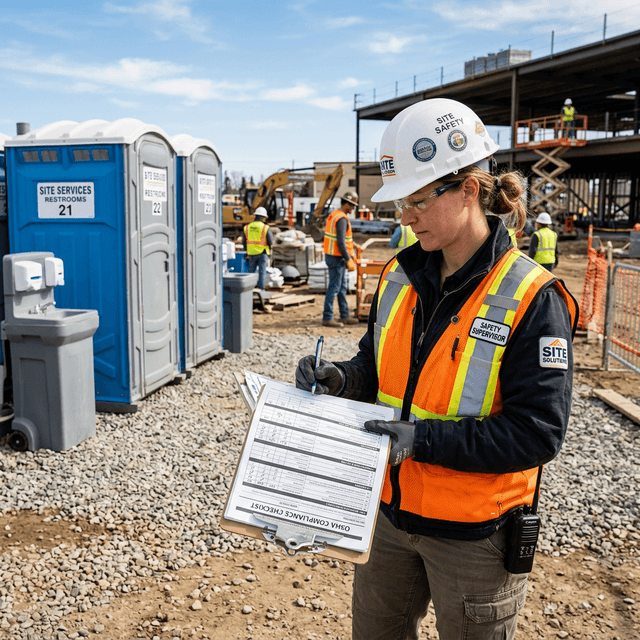
The OSHA (Occupational Safety and Health Administration) mandates a minimum of one toilet for every 20 workers on a construction site, with additional units required as the workforce scales. Non-compliance results in citations starting at $16,131 per violation.
General Contractor Relationship Management
Winning and retaining construction site contracts requires building strong relationships with general contractors (GCs) who control the subcontractor selection process:
- Pre-Bid Consultation: Offer free unit-count calculations during the GC's project bidding phase, positioning your company as a knowledgeable partner rather than a commodity vendor.
- Flexible Scaling: Guarantee the ability to add or remove units within 24 hours as the workforce size fluctuates during different construction phases.
- Automated Billing: Provide a single monthly invoice tied to the actual unit count deployed, not estimates, eliminating billing disputes.
- Compliance Documentation: Automatically generate OSHA compliance reports showing the unit-to-worker ratio, protecting the GC from regulatory fines.
- Emergency Response: Guarantee same-day emergency delivery if a unit is vandalized or a sudden workforce surge requires additional capacity.
General contractors award multi-year contracts to vendors who eliminate administrative friction. For more on fleet management, read our guide on Fleet Management for Portable Toilet Operators.
Contract Negotiation Tactics for General Contractors
Winning construction site contracts requires understanding the general contractor's decision-making process. GCs evaluate portable toilet providers on four criteria in this order: reliability, compliance documentation, price, and responsiveness. Price is rarely the primary factor because a single OSHA violation costs more than an entire year of premium portable toilet service.
The most effective sales approach presents a compliance-first value proposition. Lead with your automated OSHA ratio calculator that adjusts unit count as the workforce scales up during different construction phases. Show the GC your digital servicing log that they can access anytime to verify pump-out dates and chemical treatment records. Demonstrate your automated delivery and pickup scheduling that eliminates the phone calls GCs currently make to coordinate logistics.
Contract duration directly impacts profitability. A thirty-day construction site rental generates thin margins after accounting for delivery, pickup, and administrative costs. A twelve-month commercial construction contract with weekly servicing generates compounding profitability because the delivery cost is amortized over a much longer revenue period. Offer a five percent discount for contracts exceeding six months and a ten percent discount for contracts exceeding twelve months to incentivize longer commitments.
Payment terms represent another negotiation lever. Offering net-thirty terms to established GCs with verified credit reduces friction during the sales process. Requiring prepayment from new or unverified contractors protects cash flow without offending the customer when framed as standard onboarding procedure.
Telematics Integration for Long-Term Construction Contracts
Securing a long-term construction contract is only the first hurdle; retaining it requires flawless execution of the servicing schedule over months or years. General contractors on major commercial projects operate under intense regulatory scrutiny, and they pass this pressure down to their subcontractors. If a municipal health inspector sites a construction project for overflowing sanitation facilities, the GC will aggressively seek to replace the portable toilet provider.
To insulate themselves against this risk and justify premium contract pricing, sophisticated operators are integrating hardware telematics directly into their deployed units and pump trucks, linking them to their central dispatch software. This creates an auditable, immutable chain of custody for every servicing event that manual paper logs cannot replicate.
At the hardware level, RFID tags or weatherproof QR codes are permanently affixed to the interior of every portable toilet deployed to the construction site. When the service technician arrives, they must physically scan the tag using their mobile dispatch app before the software allows them to log the unit as serviced. This GPS-stamped and time-stamped scan definitively proves that the technician was standing inside the unit. It eliminates the "drive-by" servicing problem where a rushed driver marks a unit as clean without actually leaving the cab of the pump truck.
Furthermore, advanced fleet telematics installed on the vacuum trucks monitor the engagement of the PTO (Power Take-Off) vacuum pump. The dispatch software cross-references the GPS location of the truck, the exact time the PTO was engaged, the duration of the pumping sequence, and the RFID scan from the technician. If a unit is scanned, but the PTO sensor indicates the vacuum pump was never engaged, the system automatically flags the event for managerial review.
When an operator can present this level of verifiable, sensor-backed compliance reporting to a general contractor, price negotiations fundamentally change. The GC is no longer buying a plastic box and a weekly visit; they are buying guaranteed, mathematically proven regulatory compliance.
Multi-Phase Project Inventory Forecasting
Large-scale commercial and residential development projects do not have static sanitation requirements; their needs fluctuate wildly across the lifecycle of the project. A provider who simply drops off five units on day one and leaves them there for two years is failing to serve the client efficiently and is likely leaving money on the table.
Inventory forecasting for multi-phase projects requires understanding the labor density of different construction stages. During the initial site grading and foundation phase, the workforce is typically small, consisting primarily of heavy equipment operators. The portable toilet requirement is minimal, often just one or two units.
However, as the project transitions into the framing and mechanical rough-in phases, labor density explodes. Framing crews, electricians, plumbers, and HVAC technicians arrive on site simultaneously. A project that required two units in month one might require fifteen units by month four. If the portable toilet provider relies on the GC to call and request additional units, they risk the GC shopping around or forgetting entirely, leading to unsanitary conditions and OSHA violations.
Advanced dispatch and contract management software handles this through predictive phase modeling. During the initial contract negotiation, the operator inputs the project's high-level construction schedule. The software calculates a predictive deployment curve, automatically generating work orders to deliver additional units exactly when the framing crews are scheduled to arrive, and subsequently generating removal orders when the project shifts into the lower-density finishing phases involving painters and trim carpenters.
This proactive approach locks in the maximum possible revenue for the operator by ensuring they capture the peak demand curve of the project without waiting for the customer to ask. It also solidifies the operator's status as a strategic partner rather than a passive vendor, making it exceedingly difficult for competitors to displace them on the GC's next major development.
The integration of dynamic scheduling also provides a strategic advantage when negotiating contract renewals with major general contractors. By demonstrating precise operational execution across the initial contract term, the operator shifts the renewal conversation from unit pricing to total value delivered, effectively neutralizing lower-priced but less reliable competitors.
The long-term financial modeling of construction contracts requires careful attention to the cost of capital tied up in the deployed assets. A standard unit sitting on a residential construction site for six months generates a steady, predictable cash flow, but it also represents five to seven hundred dollars of immobilized capital. Operators must continuously analyze the "Return on Capital Employed" (ROCE) for these long-term deployments compared to short-term, high-margin weekend event rentals. The most sophisticated operators use dispatch software to calculate the optimal fleet ratio, ensuring they have enough units committed to stable construction contracts to cover fixed monthly overhead (insurance, truck financing, facility rent), while reserving a sufficient percentage of the fleet for the highly profitable, volatile special event market.
Seasonal pricing adjustments for construction contracts should reflect the increased servicing frequency required during summer heat and the antifreeze treatment costs incurred during winter operations.
The payment collection process for construction contracts differs from event rentals in ways that impact cash flow management. Construction GCs typically pay on net-thirty or net-sixty terms, meaning the operator must finance thirty to sixty days of service before receiving payment. Building this financing cost into the contract pricing ensures that longer payment terms do not erode the margin that makes the contract worthwhile. Offering a two percent discount for net-ten payment incentivizes faster payment without significantly impacting profitability.
Keep reading: