A portable toilet placed in the wrong location is a useless asset that guarantees a furious client call. Drivers often waste hours searching massive job sites for the correct drop-off point, leading to delayed routes and overflowing tanks. DispatchNode eliminates placement errors through precision GPS pinning and automated driver instructions, ensuring every unit is staged flawlessly for maximum accessibility and serviceability.
The Precision of Initial Placement
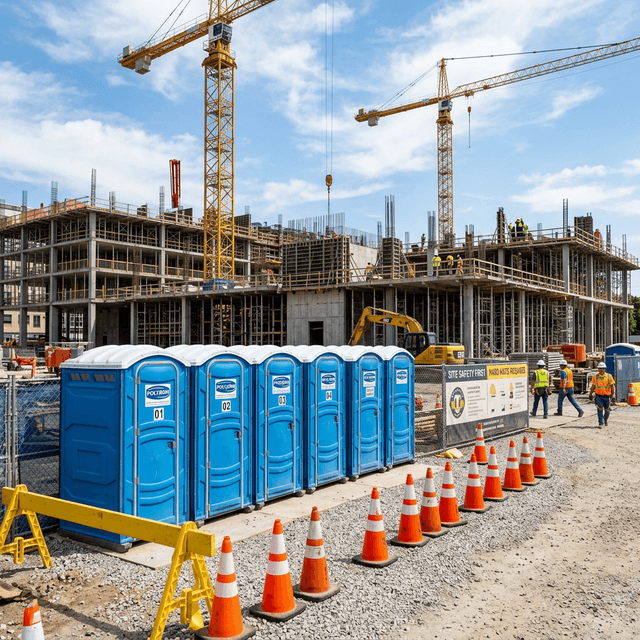
Strategic placement dictates the entire lifecycle of a portable sanitation unit. DispatchNode requires dispatchers or clients to drop a highly accurate GPS pin on a digital map during the booking process, ensuring drivers know exactly where to stage the unit. Placing a unit on unlevel ground or behind an area that will later be fenced off guarantees future service failures and massive operational headaches.
When a standard address is provided for a massive commercial construction site, it is functionally useless. A fifty-acre development might have dozens of active sub-zones. Without specific coordinates, the driver must track down the site superintendent, wasting valuable route time. The AI dispatch system resolves this by sending a confirmation link to the superintendent's phone, allowing them to drag and drop a pin on a satellite view of their exact desired placement location.
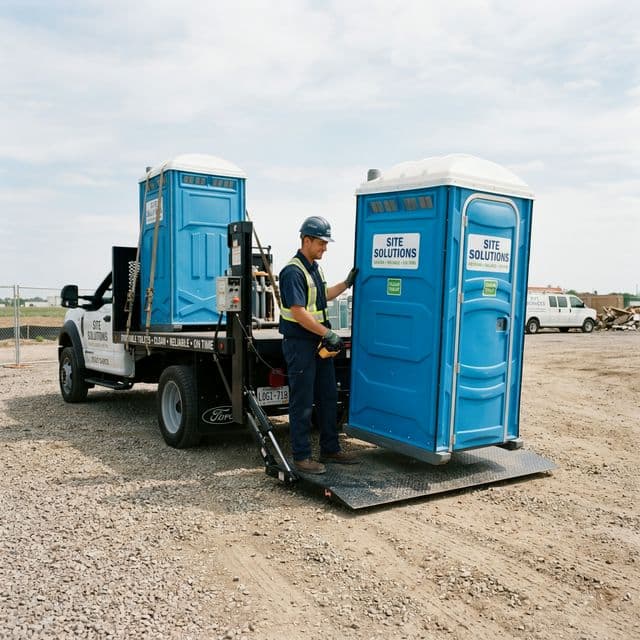
This digital precision is critical for the driver's approach. The pump truck requires significant clearance to safely deploy the unit via the lift gate. If the driver arrives and finds the requested GPS pin located in a narrow alley or on a steep incline, they cannot complete the drop. The system allows drivers to flag placement issues instantly via the mobile app, providing photographic evidence to the dispatcher before repositioning the unit to a safe, adjacent area.
Furthermore, ADA-compliant units require hyper-specific placement. Federal guidelines mandate clear, firm, and level access paths. Dropping an accessible unit in deep mud or gravel violates compliance standards. The software explicitly highlights ADA units on the driver's route manifest, triggering an automated checklist that requires the driver to verify and document the structural integrity of the placement ground before leaving the site.
Staging for Event Logistics
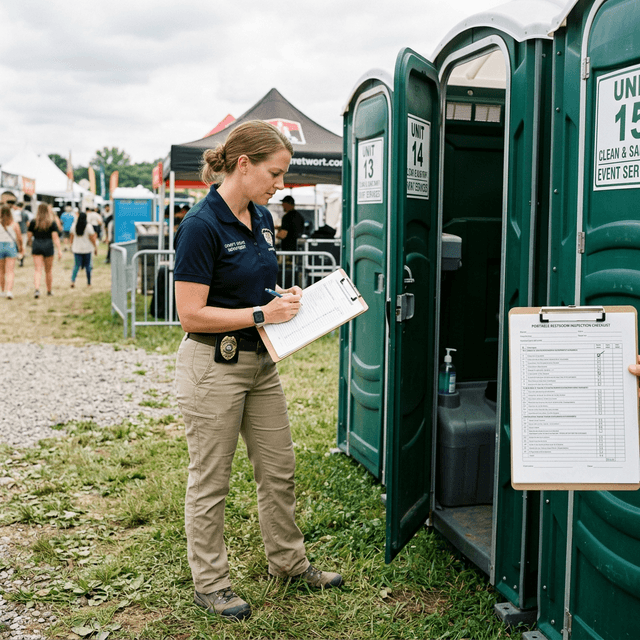
Massive festivals and events require coordinated staging of dozens or hundreds of units in tight clusters. DispatchNode models these deployment clusters algorithmically, ensuring that banks of standard units, handwashing stations, and ADA facilities are grouped efficiently to manage crowd flow while maintaining strict access corridors for mid-event service vehicles.
Dropping fifty units at a music festival is a highly choreographed operation. If the units are staged too close together, the doors cannot fully open; if they are placed too far apart, the footprint consumes valuable vendor space. The dispatch platform provides drivers with a digital staging schematic. This schematic details the exact spacing and orientation of each unit bank, ensuring a uniform and professional appearance.
Crucially, the staging must account for the service truck's approach during the event. If a bank of toilets is completely surrounded by vendor tents or food trucks, the vacuum truck cannot reach the tanks for mid-event pumping. The system forces event planners to designate and agree to a "service corridor" during the booking phase. The driver's app confirms that this corridor remains unobstructed during the initial deployment phase.
By automating the staging logic, operators can deploy massive inventories with minimal supervision. Junior drivers can execute complex event drops flawlessly by simply following the digital schematic on their tablet. This reduces the reliance on highly experienced, expensive senior drivers for basic event setup, driving massive margin improvements across the entire operation.
Coordinating Efficient Pickups
Recovering units at the end of a contract is often more chaotic than the initial deployment. DispatchNode generates automated pickup routes based on contract end dates, grouping retrievals by geographic proximity to minimize windshield time and prevent expensive assets from sitting abandoned and unpaid on finished job sites.
When a construction project concludes, the general contractor rarely calls to terminate the sanitation service; they simply pack up their equipment and leave. Without automated contract tracking, a portable toilet might sit on an empty lot for weeks, generating zero revenue while remaining exposed to theft and vandalism. The software tracks every active deployment, triggering a retrieval work order the moment a billing cycle is discontinued.
The pickup process is highly susceptible to logistical friction. Units are frequently blocked by heavy machinery or locked behind construction gates. The driver's mobile application stores the gate codes and site contact information captured during the initial booking. If a unit is blocked, the driver logs a "Dry Run" in the app, capturing a photo of the obstruction. The system immediately invoices the contractor for a wasted trip fee, protecting the operator's margins.
For massive event retrievals, the system utilizes "swarm routing." Instead of sending a single truck to recover fifty units, the algorithm splits the recovery across multiple returning trucks that are ending their daily routes near the event site. This distributed recovery method clears the event grounds rapidly without requiring dedicated, low-margin retrieval shifts, maximizing the efficiency of the entire fleet.
The Financial Impact of Logistics
Perfecting delivery, staging, and pickup logistics is not merely an operational goal; it is the primary driver of profitability in the portable sanitation industry. DispatchNode eliminates the wasted fuel, hourly labor overruns, and lost asset depreciation associated with chaotic routing, allowing operators to run a massive fleet with ruthless financial efficiency.
Every minute a driver spends searching for a drop-off point or struggling with a blocked pickup destroys the profit margin of that rental. The AI routing and GPS precision ensure that drivers execute their stops with military efficiency. The dashboard tracks the exact duration of every stop, identifying slow drivers or problematic client sites that are draining operational resources.
Furthermore, the system protects the physical assets. Units that are staged incorrectly on uneven ground are highly susceptible to tipping, resulting in catastrophic damage to the unit and severe environmental cleanup costs. The digital checklists enforced by the driver app ensure that every unit is staged safely and securely, drastically reducing the annual capital expenditure required to replace damaged inventory.
By leveraging AI and digital mapping, sanitation companies transform a brute-force logistical challenge into a highly refined, data-driven operation. They can guarantee delivery windows, execute complex event staging flawlessly, and recover their assets immediately upon contract completion. This operational excellence secures the most lucrative commercial contracts and guarantees long-term dominance in the local market.
Placement Best Practices by Site Type
Correct placement of portable toilets on a job site or event venue is as important as the units themselves. Incorrect placement leads to worker complaints, ADA violations, and health department citations.
Construction sites require units to be placed on level ground within 200 feet of the primary work area, away from excavation zones and heavy equipment paths. Event venues require units clustered near high-traffic areas (entrances, food courts, beer gardens) with clear directional signage. Residential construction requires discreet placement with the door facing away from the street and neighboring properties.
The OSHA (Occupational Safety and Health Administration) does not specify exact placement distance, but industry best practice and arbitration precedent suggest that units placed more than a 3-minute walk from the work area create de facto non-compliance by discouraging use.
Delivery Logistics Checklist
Efficient delivery minimizes driver time on site and prevents costly callbacks for repositioning:
- Pre-Delivery Site Survey: Use Google Maps satellite view to identify the delivery access point, ground surface, and optimal placement zone before the truck leaves the yard.
- Ground Assessment: Confirm that the delivery surface can support the unit's weight. Soft mud, steep grades, and standing water require ground preparation or alternative placement.
- Clearance Verification: Ensure the delivery truck can access the placement zone without requiring traffic control, permits, or utility line clearance.
- Photo Documentation: Photograph each unit's placement from two angles upon delivery. This protects the operator from disputes about unit condition or placement location.
- Customer Confirmation: Text the customer a delivery confirmation with photos and a link to request repositioning within 24 hours if the placement needs adjustment.
For more on inventory management, read our guide on Tracking Portable Toilet Inventory Utilization.
Quick Reference Data
| Site Type | Optimal Placement | Ground Requirement | Access Notes |
|---|---|---|---|
| Construction | Within 200ft of work area | Level, firm surface | Away from heavy equipment |
| Wedding Venue | Screened, near parking | Level grass or pavement | Discreet from ceremony |
| Festival | Near food/beverage areas | Any firm surface | High-traffic visibility |
| Residential | Driveway or side yard | Level driveway | Door away from street |
Spatial Telemetry and Precision Placement Logistics
The delivery of a portable toilet is not merely a transportation task; it is an exercise in precision spatial logistics. The final placement of the unit dictates its accessibility, its susceptibility to environmental damage, and the efficiency of all future servicing events. Relying on a driver's intuition or vague customer instructions—"just put it out back near the fence"—inevitably leads to placement errors that cascade into costly operational failures.
Advanced dispatch platforms utilize spatial telemetry to eliminate this ambiguity. During the booking process, the customer receives a secure SMS link requesting a "digital site survey." The customer uses their smartphone to drop a precise GPS pin on an aerial map of the property, indicating exactly where the unit should be placed. The software immediately analyzes this coordinate against municipal GIS data, verifying that the placement does not violate local setback ordinances or block access to fire hydrants.
Furthermore, the driver's mobile application utilizes this exact GPS coordinate to provide micro-routing upon arrival at the site. The application overlays the requested placement location onto the driver's screen, ensuring they drop the unit within inches of the approved spot. This precision is critical for long-term construction sites where units must be carefully positioned to avoid interfering with heavy equipment traffic or future excavation phases.
To verify execution, the driver must capture a timestamped, geolocated photograph of the placed unit through the app before the delivery work order can be closed. This photographic evidence serves a dual purpose: it proves to the customer that the unit was delivered exactly as requested, and it provides a permanent visual record of the unit's condition at the time of delivery, protecting the operator from fraudulent damage claims later in the rental period.
The Micro-Economics of Delivery Density
The profitability of the delivery phase is entirely dependent on route density. Dispatching a flatbed truck carrying a single portable toilet to a site thirty miles away is an economically disastrous proposition; the fuel and labor costs of the two-way trip completely consume the first month's rental margin. Fleet managers must orchestrate deliveries to maximize the number of units dropped per mile driven.
Achieving high delivery density requires a dispatch algorithm capable of complex spatial-temporal clustering. The algorithm must group pending delivery orders not just by geographic proximity, but by temporal constraints. If an operator has six deliveries required on the north side of the city, the algorithm sequences them to ensure the truck can execute a continuous, linear route, dropping units sequentially without backtracking.
Crucially, this optimization must account for the physical constraints of the delivery vehicle. A standard flatbed might hold fourteen standard units, but only eight ADA-compliant units due to their larger footprint. The algorithm calculates the precise volumetric load of the truck based on the specific mix of unit types requested in the cluster, ensuring the driver leaves the yard with a fully optimized load.
The financial impact of maximizing delivery density is profound. By utilizing algorithmic clustering to increase the average number of units delivered per dispatch from four to eight, the operator cuts their delivery labor and fuel costs per unit in half. This operational leverage allows the independent operator to maintain highly competitive pricing while preserving superior profit margins, providing a structural advantage over competitors who rely on manual, inefficient delivery routing.
The environmental impact of inefficient delivery routing is increasingly becoming a liability for operators bidding on municipal or government contracts. Many large cities are implementing strict emissions reporting requirements for all vendors operating within their jurisdiction. An operator relying on manual, inefficient dispatching will generate a significantly larger carbon footprint per delivered unit than a technologically advanced competitor. By utilizing algorithmic spatial clustering and dynamic routing, the operator mathematically minimizes their diesel consumption and associated emissions. This efficiency can be quantified and presented in contract bids as a dedicated "Sustainability and Emissions Reduction Report" generated directly by the dispatch platform. In a procurement environment that increasingly weighs environmental impact alongside cost, this technological capability frequently serves as the deciding factor in winning highly lucrative, multi-year government sanitation contracts.