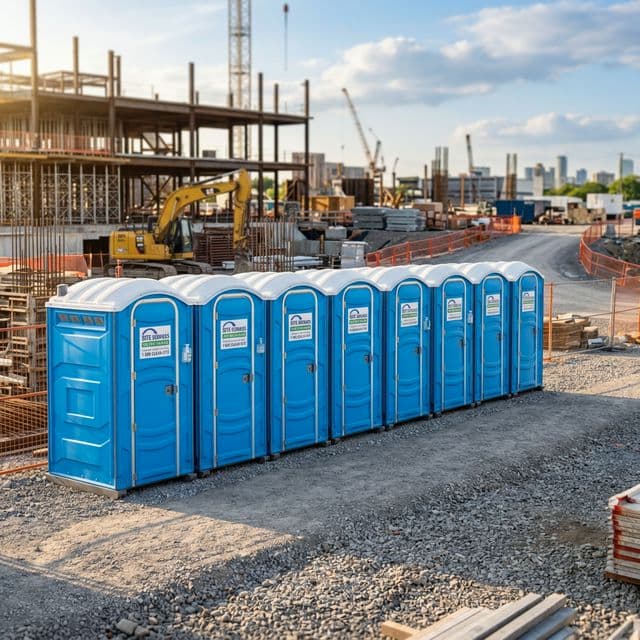
ADA requires at least 1 accessible portable restroom for every 20 standard units (or any cluster of units). Compliant units must provide 60-inch interior turning radius, 34-inch max threshold height, grab bars, and an accessible path from the event area.
ADA Requirements for Portable Restrooms
ADA non-compliance for portable sanitation can trigger penalties of $75,000 for a first offense and $150,000 for subsequent violations under the Americans with Disabilities Act. These penalties apply to the event organizer and the rental provider jointly.
The Americans with Disabilities Act does not have a carve-out for temporary facilities. If you place portable restrooms at any location open to the public, ADA compliance is mandatory. This applies to construction sites, festivals, weddings, corporate events, and any other scenario where portable restrooms serve the public or employees.
Most operators understand they need "at least one wheelchair-accessible unit." But the actual requirements go well beyond having a bigger box. This guide covers every specification.
Unit Specifications
An ADA-compliant portable restroom must meet these minimum interior specifications:
| Specification | Requirement |
|---|---|
| Floor space | 60" x 60" minimum clear area |
| Door opening | 32" minimum clear width |
| Threshold height | 0.5" maximum (beveled edge) |
| Grab bars | Both sides of toilet, 33-36" above floor, rated for 250 lbs |
| Toilet seat height | 17-19" from floor (higher than standard 15") |
| Interior maneuvering | 60" turning radius clear of all fixtures |
Common violation: Many "ADA units" on the market have a floor threshold that exceeds the 0.5-inch maximum. This happens when the unit is placed on uneven ground without a ramp. Always carry portable ramp sections to ensure threshold compliance at every site.
Placement Rules
Having the right unit is only half the requirement. Placement determines whether the unit is actually accessible.
- -Position ADA units on firm, level ground (gravel, concrete, or compacted surface)
- -Ensure an accessible path at least 36 inches wide connects the ADA unit to the main event area
- -The accessible path must be free of steps, steep slopes (max 5% grade), and obstacles
- -ADA units must be closest to the event area, not placed at the far end of a row
- -Signage with the International Symbol of Accessibility must be posted on the unit
The path requirement is where most operators fail. They place a perfectly compliant ADA unit at the end of a grassy field with no firm path connecting it to the venue. A wheelchair cannot traverse wet grass, gravel deeper than 2 inches, or unpaved surfaces with ruts. The unit itself passes inspection, but the inaccessible path creates a violation.
How Many ADA Units Do You Need?
The ratio depends on total unit count and local jurisdiction:
| Total Standard Units | Minimum ADA Units |
|---|---|
| 1 - 20 | 1 |
| 21 - 40 | 2 |
| 41 - 60 | 3 |
| 61+ | 1 per 20 standard units |
"Some municipalities require a higher ratio. Always check local health department guidelines in addition to federal ADA standards. When in doubt, add an extra ADA unit."
Quoting ADA Units to Clients
Many clients do not proactively ask for ADA units. This creates a liability risk for both the client and the rental company. Always include ADA units in your standard quote. Frame it as compliance assistance, not an upsell.
- Calculate total unit count based on headcount and OSHA/event formulas.
- Apply the 1-per-20 ADA ratio automatically.
- Add ADA units as a line item in every quote.
- Include accessible path assessment as part of your site survey.
- Document the placement plan with photos for your compliance file.
Clients appreciate the proactive approach. Event planners and general contractors face personal liability for ADA violations, and most are grateful when their rental provider handles compliance without being asked.
ADA Dimensional Requirements by Unit Type
The Americans with Disabilities Act (ADA) mandates specific interior dimensions for accessible portable restrooms. Non-compliance exposes event organizers and construction site managers to federal discrimination lawsuits.
The minimum interior floor space for an ADA-compliant portable restroom is 60 inches by 60 inches, providing sufficient room for a wheelchair to execute a full 360-degree turn. The door opening must be a minimum of 32 inches wide and must swing outward, not inward. Interior grab bars must be installed on at least two walls at a height of 33 to 36 inches from the floor. The toilet seat height must be between 17 and 19 inches, significantly higher than standard portable toilet seats.
These are not suggestions; they are federal requirements. A single non-compliant unit at a public event can trigger a complaint that results in fines of $75,000 for a first offense and $150,000 for subsequent violations under Title III of the ADA.
Placement Compliance Checklist
Even a perfectly manufactured ADA unit becomes non-compliant if placed incorrectly on site. The following checklist ensures every placement meets federal and local accessibility standards:
- Ground Surface: The unit must be placed on a firm, level, stable surface. Gravel, mud, or grass slopes violate accessibility requirements because wheelchair users cannot safely navigate them.
- Path of Travel: There must be an accessible route from the main event area to the ADA unit, with no grade exceeding 1:12 (one inch of rise per twelve inches of run).
- Signage: The ADA unit must be clearly marked with the International Symbol of Accessibility at a height visible from the event pathway.
- Proximity: ADA units must be located in the same general area as standard units, not isolated in a distant corner of the site.
- Door Clearance: Ensure a minimum 60-inch clearance zone in front of the outward-swinging door to allow wheelchair approach and maneuvering.
For a broader analysis of unit requirements at construction sites, read our guide on OSHA Portable Toilet Requirements.
ADA Placement Engineering and Site Planning
ADA-compliant portable restroom placement requires engineering-level site planning that goes beyond simply positioning a larger unit alongside standard units. The Americans with Disabilities Act specifies that accessible facilities must be located on an accessible route from the primary activity area, which means the path to the unit must be firm, stable, and slip-resistant with no grade steeper than one-to-twelve.
On construction sites, this requirement often conflicts with the terrain conditions that make portable toilets necessary in the first place. Muddy, uneven ground is the norm on active construction sites, and placing an ADA unit on soft soil creates a sinking hazard that can render the unit inaccessible within days. Operators should recommend ground-level plywood platforms or compacted gravel pads for ADA unit placement, adding a fifteen to twenty-five dollar material surcharge to the delivery fee to cover the cost.
Event venues present different ADA placement challenges. Festival grounds must position ADA units within the same general cluster as standard units to avoid segregating disabled attendees. The accessible route from the event's primary gathering areas to the ADA unit must be clearly marked with directional signage and free of obstacles including tent stakes, power cables, and vendor equipment.
Operators who proactively address ADA placement during the quoting process differentiate themselves from competitors who treat accessibility as an afterthought. Including a placement diagram with every quote that shows the ADA unit position relative to the access route demonstrates compliance expertise that event planners and construction managers value.
Hardware Architecture of ADA-Compliant Sanitation
Understanding the structural differences between standard portable toilets and ADA-compliant units is critical for operators, as it directly impacts transport logistics, field maintenance, and long-term asset depreciation. A standard portable toilet has a footprint of roughly four feet by four feet, with an empty weight of approximately one hundred sixty to two hundred pounds depending on the manufacturer and the tank capacity. An ADA-compliant unit requires a minimum footprint of sixty-two inches wide and sixty-two inches deep to allow a wheelchair to execute a complete three-hundred-sixty-degree turn. This expanded footprint, combined with reinforced structural elements, increases the empty weight to between two hundred fifty and three hundred fifty pounds.
The door assembly represents one of the most significant engineering challenges in ADA unit design. The Americans with Disabilities Act mandates a clear opening width of at least thirty-two inches, though most modern compliant units provide thirty-six inches to ensure comfortable access for motorized chairs. Furthermore, the door must be easily operable with a single hand, requiring no tight grasping, pinching, or twisting of the wrist. The closing mechanism must also be carefully calibrated; it must close securely to ensure privacy but cannot require more than five pounds of force to push or pull open. For operators, this means the door hinges and pneumatic closers on ADA units require twice as much preventative maintenance as standard units, as heavy usage at construction sites or festivals can quickly knock these precision mechanisms out of alignment, instantly rendering the unit non-compliant.
The interior hardware is equally specialized. Grab bars must be installed horizontally along the rear wall and the side wall closest to the toilet seat. These bars must be capable of supporting two hundred fifty pounds of continuous force without deflecting or separating from the wall panel. Because portable toilet walls are constructed from high-density polyethylene rather than structural framing, manufacturers must use reinforced backing plates on the exterior of the unit to anchor the grab bars securely. When servicing these units, technicians must visually inspect the anchor bolts during every pump-out to ensure vibrations from transport have not loosened the hardware.
The waste tank design in ADA units also differs fundamentally from standard models. Standard units feature a bench-style tank that spans the entire rear of the unit. ADA units must provide clear floor space adjacent to the toilet for lateral wheelchair transfers. This requires a much smaller, off-center tank footprint. To maintain sufficient waste capacity (typically thirty-five to fifty gallons), the tank must sit higher or utilize a different geometric profile, which can alter how the technician approaches the pump-out process. Many modern ADA units also incorporate ground-level floor designs, eliminating the step-up required by older models, but making the floor more susceptible to damage from uneven placement on rocky construction sites.
From a financial perspective, the capital expenditure required to acquire an ADA-compliant unit is generally double to triple the cost of a standard unit. Given that the typical rental premium charged for an ADA unit is only thirty to fifty percent higher than a standard unit, the payback period is considerably longer. Operators must manage this by ensuring high utilization rates for their ADA inventory, often cross-deploying them between construction sites during the week and special events on the weekends.
Economic Modeling of ADA Fleet Allocation
The mathematical relationship between ADA inventory percentage and overall fleet profitability requires precise modeling to prevent capital misallocation. For an operator managing a fleet of one thousand units, determining exactly how many should be ADA-compliant is not a matter of guesswork; it is derived from local regulatory environments and target market composition.
Consider a hypothetical mid-sized operator targeting a sixty-forty split between construction and special events. Federal OSHA regulations and most state building codes require one ADA-compliant unit for every twenty workers on a commercial construction site if standard units are provided. However, special events, governed by the Department of Justice's Title III ADA regulations, typically require a minimum of five percent of all portable toilets at a single location to be accessible, and never less than one.
If this operator allocates ten percent of their capital budget to ADA units, they will likely experience inventory constraints during peak festival season, forcing them to sub-rent from competitors at wholesale rates—destroying their margin on those units. Conversely, if they allocate twenty-five percent of their fleet to ADA units, they tie up capital in expensive assets that may sit idle in the yard during winter months when event demand drops to zero.
The optimal mathematical balance for a diversified operator typically lands between twelve and fifteen percent of total fleet capacity. At a one-thousand-unit fleet size, maintaining one hundred twenty to one hundred fifty ADA units allows the operator to bid on large municipal contracts and multi-stage festivals without risking catastrophic under-utilization during the off-season.
Furthermore, the pricing strategy for ADA units must reflect the increased delivery complexity. Because they weigh significantly more and have a wider footprint, ADA units occupy more deck space on a delivery flatbed. A truck that can carry fourteen standard units might only be able to carry eight ADA units. This reduction in route density means the cost to deliver an ADA unit is proportionally higher than the cost to deliver a standard unit. Operators using advanced dispatch platforms automatically apply a logistics multiplier to ADA delivery quotes, ensuring that the true cost of transport is captured in the final price rather than eating into the net profit margin.
Documentation of ADA compliance decisions should include photographs of unit placement showing the accessible route, ground surface measurements, and distance calculations from the primary activity area.
Operators who invest in ADA compliance training for their delivery crews gain a measurable competitive advantage when bidding on government contracts, school district projects, and public event permits. Municipal procurement officers and event permitting authorities increasingly require documented ADA compliance expertise as a prerequisite for vendor approval, making this knowledge a revenue-generating qualification rather than merely a regulatory obligation.
Keep reading: