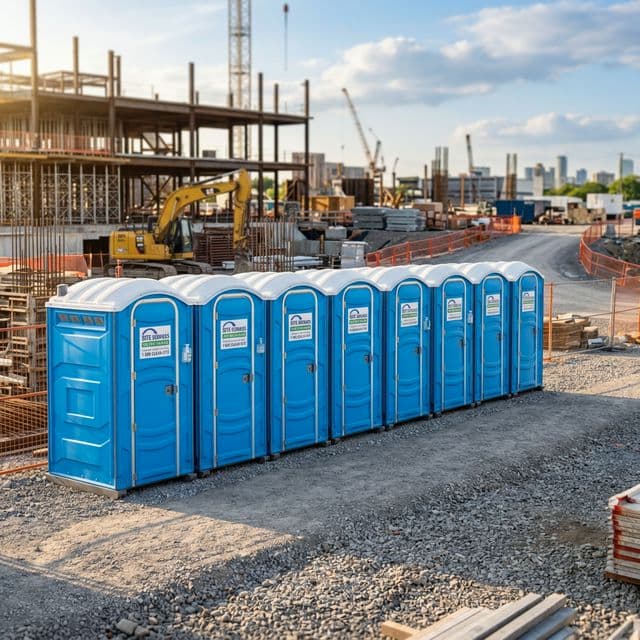
OSHA Standard 29 CFR 1926.51(c) requires a minimum of 1 toilet per 20 workers on construction sites. Events follow local health department formulas based on attendance, duration, and alcohol availability. Getting the count wrong leads to fines, complaints, and contract cancellations.
The OSHA Baseline
OSHA violations for insufficient sanitation on construction sites carry fines starting at $16,131 per incident for serious violations, increasing to $161,323 for willful or repeated offenses (2026 penalty schedule).
Portable toilet requirements are not suggestions. They are federal and local regulations with real financial penalties. The core rule is straightforward: 1 unit per 20 workers on any construction site. But the real-world calculation is more nuanced because worker counts fluctuate, shifts overlap, and local health departments often impose stricter standards than the federal minimum.
Construction Site Formula
The base OSHA requirement scales linearly:
| Workers On Site | Minimum Units Required |
|---|---|
| 1 - 20 | 1 |
| 21 - 40 | 2 |
| 41 - 60 | 3 |
| 61 - 80 | 4 |
| 81 - 100 | 5 |
| 100+ | 5 + 1 per additional 40 workers |
Adjustment factors that increase the count:
- -Sites with no nearby permanent restrooms: add 1 additional unit
- -Multi-story buildings where ground-level units are 5+ minutes away: add 1 unit per 3 floors
- -Sites with multiple distinct work zones separated by more than 500 feet: 1 unit per zone
- -Shifts longer than 10 hours: multiply the base count by 1.5
- -Sites requiring ADA-compliant units: at least 1 ADA unit for every 20 standard units (minimum 1)
The handwash trap: OSHA also requires handwashing stations near each toilet cluster. Many operators quote units but forget handwash stations, which leads to compliance failures during inspections. Always include handwash stations in your quote at a ratio of 1 station per 4 units.
Event Formula
Events use a different formula based on attendance, duration, and whether alcohol is served:
The full event calculation:
- Start with the base ratio: 1 unit per 100 attendees (no alcohol) or 1 per 60 (with alcohol).
- Multiply by duration factor: events over 4 hours multiply by 1.5, over 8 hours multiply by 2.
- Add 10% if the event is outdoors with no nearby permanent facilities.
- Add 1 ADA-compliant unit for every 20 standard units (minimum 1).
- Add VIP/luxury trailer units if the event budget supports premium restroom experiences.
Common Quoting Mistakes
After analyzing thousands of rental quotes, the most costly mistakes are:
| Mistake | Consequence |
|---|---|
| Quoting OSHA minimum only | Local health dept. may require 1.5x to 2x the OSHA minimum. |
| Forgetting shift overlaps | Peak concurrent headcount may be 30% higher than "workers on site." |
| No ADA units quoted | ADA non-compliance triggers separate penalties under the ADA. |
| Ignoring service frequency | Hygiene complaints within 48 hours for units at capacity. |
The safest strategy is to quote 10-15% above the calculated minimum. The marginal cost of an extra unit is insignificant compared to a compliance fine or a contract cancellation.
Using an AI Booking Agent as Your Calculator
Modern portable toilet rental companies let the AI handle the unit count calculation during the booking call. When a customer calls, the AI agent asks the right questions (number of people, duration, alcohol, site type) and calculates the count in real time.
"This eliminates two problems: the customer does not need to know the formula, and the operator does not need to worry about a new employee undercounting. The AI agent quotes the correct count, explains why, and books the order in 5 minutes."
Calculator Methodology and Input Variables
An accurate OSHA portable toilet calculator requires more than a simple worker-to-unit ratio. The algorithm must account for multiple environmental and operational factors to produce a compliant recommendation.
The core inputs include total workforce headcount, number of shifts per day, average shift duration in hours, site geographic spread in acres, and whether hazardous materials are present (which require decontamination stations). Advanced calculators also factor in seasonal temperature, which affects usage frequency, and proximity to permanent restroom facilities that may reduce portable unit requirements.
The OSHA Construction Standards (29 CFR 1926.51) provides the regulatory foundation for all calculator algorithms, but practical experience shows that adding 10-15% above the OSHA minimum prevents complaints and improves worker satisfaction.
Beyond Basic Compliance: Best Practices
Meeting the bare OSHA minimum is legally sufficient but operationally insufficient. Experienced operators recommend exceeding the minimum to prevent complaints and position the business as a premium provider:
- Add 15% Buffer: Deploy 15% more units than the OSHA minimum requires to accommodate usage peaks during break times and shift changes.
- Strategic Placement: Position units within 200 feet of the primary work area. OSHA does not specify placement distance, but worker satisfaction plummets when units are more than a 3-minute walk away.
- Hand-Wash Stations: Provide one hand-wash station for every two portable toilets. While not always mandated, this demonstrates compliance maturity to inspectors.
- Covered Walkways: In regions with heavy rain or extreme heat, consider covered pathways to units. This reduces "holding" behavior that leads to dehydration and health issues.
- Lighting: If any work occurs during pre-dawn or post-dusk hours, ensure units have interior lighting for safety and usability.
For more on health inspections, read our guide on Health Department Inspection for Portable Toilets.
Ensuring Calculator Accuracy
The most important factor in OSHA calculator accuracy is accounting for the variables that simple ratio calculators miss. Multiple shifts on the same site require proportionally more units because peak usage occurs at shift changes when both crews are present simultaneously. Sites with hazardous materials require dedicated decontamination stations that are separate from standard sanitation units.
Advanced Calculator Considerations for Complex Sites
Large-scale construction projects introduce calculator variables that simple ratio tools cannot handle. Multi-story building projects require units on every third floor because workers lose productive time traveling to ground-level facilities. Sites with multiple sub-contractors operating on different schedules need separate unit allocations for each crew's active hours. Pipeline and linear construction projects spanning several miles require units staged at half-mile intervals along the route because centralized placement creates unacceptable walking distances.
The calculator must also account for gender-specific facilities when the workforce includes both men and women. OSHA does not mandate separate facilities for workforces under twenty, but most progressive contractors provide them regardless of legal requirements because mixed facilities generate complaints that damage worker retention. Sites with female workers should calculate a separate allocation of one unit per fifteen female workers to ensure adequate availability during peak usage periods.
Temporary office trailers with built-in restrooms can offset portable unit requirements but only if they remain accessible to all workers on site. When trailers are locked or restricted to management, they cannot be counted toward the OSHA compliance ratio. The calculator should include a field for permanent or semi-permanent facilities on site and subtract their capacity from the portable unit recommendation only when accessibility is confirmed.
Computational Compliance and Dynamic Scaling
The traditional method of calculating portable toilet requirements relies on static matrix charts printed on laminated paper in the dispatch office. A dispatcher looks at the chart: fifty workers require three units. They book the order, and those three units sit on the job site for the next eighteen months. This static approach is fundamentally flawed because construction projects are dynamic, living entities with wildly fluctuating labor densities across different phases of development.
To maintain continuous compliance without overcharging the client for unnecessary inventory, operators must transition to computational compliance models. An advanced calculator integrated into a platform like EasyPottyRental does not just provide a single number at the start of a project; it generates a dynamic scaling curve based on the project's critical path schedule.
When a general contractor initiates a contract, they input their projected labor curve: twenty workers during the foundation phase (months 1-2), eighty workers during framing and mechanicals (months 3-6), and forty workers during finishing (months 7-9). The computational engine instantly generates a staggered deployment and removal schedule. It automatically creates future work orders to deliver two additional units at the start of month three, another two units at the start of month four, and subsequently generates removal orders as the project winds down.
This automated, phase-based scaling guarantees that the general contractor is always in compliance with OSHA regulations during peak labor periods, while preventing them from paying for excess, underutilized units during the slower phases. This level of precise, algorithmic inventory management builds immense trust with commercial clients and ensures the operator maximizes the revenue yield of their entire fleet by preventing units from sitting idle on sites that no longer require them.
Legal Indemnification Through Algorithmic Records
The legal landscape surrounding occupational health violations is becoming increasingly litigious. If a construction site experiences an outbreak of a communicable disease, or if a worker files a formal complaint regarding unsanitary conditions, the resulting investigation will heavily scrutinize the site's sanitation infrastructure. In these scenarios, the general contractor will often attempt to deflect liability onto the portable toilet provider, claiming they were not supplied with adequate facilities.
An advanced, digital OSHA calculator provides a robust mechanism for legal indemnification. When a contractor utilizes the AI booking agent or the online portal to secure units, they must input their exact workforce headcount and project duration. The algorithm calculates the legally required unit count and presents the quote.
Crucially, if the contractor attempts to manually override the algorithm—for instance, requesting only two units when the system calculates that four are legally required for their workforce size—the software triggers a digital liability waiver. The contractor must explicitly acknowledge that they are choosing to order below the OSHA-recommended minimums.
This digital signature, combined with the immutable record of the system's original compliant recommendation, provides the portable sanitation operator with ironclad legal protection. If an inspector subsequently issues a fine for insufficient facilities, the operator can produce the digital audit trail proving they advised the contractor of the correct ratio and the contractor willfully chose non-compliance. This technological barrier protects the operator's business from devastating third-party liability claims that traditional paper contracts simply cannot defend against.
The algorithmic refinement of the OSHA calculator must also consider the varying accessibility requirements across different project types. While federal standards dictate the total unit count, the spatial distribution of those units across a massive commercial site—such as a multi-acre warehouse development—requires the algorithm to calculate the maximum allowable walking distance from any active work zone. This ensures that the generated deployment plan satisfies both the quantitative and spatial requirements of occupational safety regulations.
The strategic deployment of the compliance calculator as a lead generation tool creates a continuous pipeline of highly qualified prospects. By capturing leads early in their planning process, the operator establishes authority and drastically increases the probability of converting the prospect into a long-term contract.
The integration of the OSHA calculator directly into the operator's primary website transforms the tool from an internal utility into a powerful lead generation magnet. Construction project managers frequently search for "how many porta potties do I need for a job site" during the early planning phases, long before they are ready to request a formal quote. By providing an open, highly accurate, easy-to-use calculator on their homepage, the operator captures this high-intent organic search traffic. When the manager inputs their project parameters, the calculator requires an email address or phone number to deliver the final compliance report. This seamlessly transfers the prospect into the operator's CRM, triggering an automated follow-up sequence from the AI sales agent. This strategy effectively monopolizes the educational phase of the customer journey, ensuring the operator is the first and only vendor the prospect consults when they are finally ready to sign a contract.
The calculator output should include a printable PDF summary that the operator can include with every delivery as documentation that the recommended unit count meets or exceeds OSHA requirements.
The calculator should also incorporate local ordinances that may impose stricter requirements than federal OSHA standards. California, New York, and several other states maintain state-level occupational safety standards that exceed the federal minimums for portable sanitation facilities on construction sites. Operators serving multi-state territories must configure the calculator to apply the stricter standard automatically based on the project location.
The legal liability associated with providing inaccurate OSHA calculator recommendations creates a risk that operators must actively manage. If an operator recommends too few units and the construction site receives an OSHA citation, the general contractor may seek to transfer liability to the portable toilet provider who recommended the insufficient unit count. Including a disclaimer that the calculator provides recommendations based on federal minimums and that the GC is responsible for final compliance decisions provides important legal protection.
Keep reading: