When disaster strikes or a massive event scales beyond initial projections, sanitation operators face a logistical nightmare. Managing chaotic deployment requests manually leads to misrouted trucks, fuel waste, and critical sanitation failures. DispatchNode provides an AI-native routing system that calculates optimal deployment paths instantly, saving operators from catastrophic service failures and protecting public health.
The Logistics of Rapid Deployment
Emergency sanitation deployment requires routing precision that static maps simply cannot provide. DispatchNode calculates real-time variables including fleet capacity, traffic congestion, and urgent delivery requests to map the most efficient drop-off routes. This ensures that disaster relief zones and expanding events receive necessary portable toilets within the shortest possible timeframe without overburdening individual drivers.
Standard dispatching relies on human intuition, which fractures under extreme stress. When hundred-unit orders arrive simultaneously, a dispatcher cannot manually verify the location of every pump truck or transport trailer. The automated system tracks all assets via GPS and assigns the nearest available vehicle to execute the deployment. This reduces response times by up to forty percent while minimizing the carbon footprint of the operation.
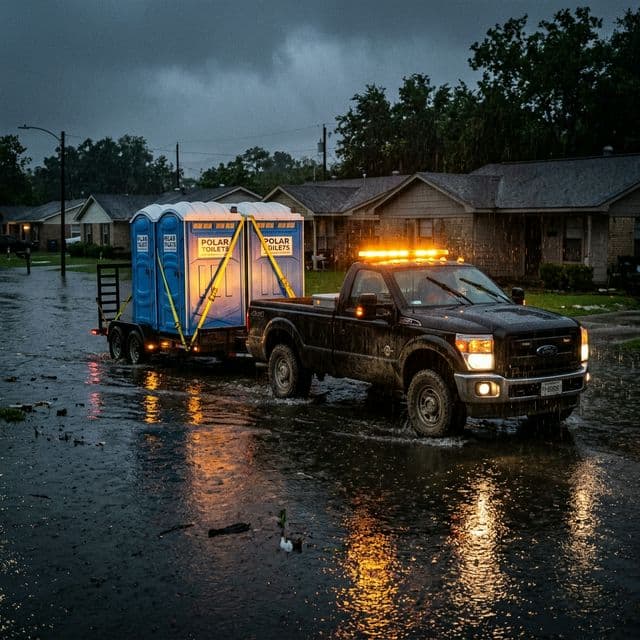
Furthermore, dynamic routing ensures that drivers are not crisscrossing the city unnecessarily. The AI clusters drop-off locations, grouping nearby sites into logical sequences. During large-scale emergencies, such as hurricanes or floods, roads are frequently impassable. The platform integrates with municipal data feeds to actively avoid road closures, recalculating the optimal path dynamically while the driver is en route.
This capability transforms a reactive service business into a proactive logistics powerhouse. Instead of apologizing for delayed deliveries, sanitation operators can guarantee precise arrival windows, securing highly lucrative municipal and disaster relief contracts that demand strict adherence to delivery service level agreements.
Maintaining Service Intervals in Chaos
Maintaining service intervals during large-scale events demands predictive analytics rather than reactive pumping. DispatchNode utilizes attendance projections and environmental data to forecast capacity limits, dispatching pump trucks exactly before units overflow. This predictive servicing prevents catastrophic sanitation breaches and ensures continuous compliance with health regulations.
A portable toilet at a music festival reaches capacity significantly faster than one on a construction site. When an operator has thousands of units deployed across a single city, tracking the status of each individual unit is impossible without software. The algorithm processes historical utilization rates against current crowd densities to establish a customized pumping schedule for every unit in the field.
As drivers complete their routes, the system automatically logs the volume pumped and cross-references it with local tipping fee locations. If a specific dump site reaches capacity or experiences long queue times, the software automatically reroutes the driver to the next most efficient disposal facility. This eliminates idle time and maximizes the total number of units a single truck can service in a shift.
Crucially, the system provides automated manifests for every pump-out. In disaster scenarios, government agencies require meticulous documentation of all sanitation services for reimbursement purposes. The digital manifest is generated instantly upon service completion, containing GPS coordinates, time stamps, and volume data, ensuring the operator gets paid without bureaucratic delays.
AI Voice Booking for Emergency Requests
Handling sudden surges in inbound calls requires an AI voice agent capable of capturing complex delivery instructions under pressure. DispatchNode deploys a multilingual AI receptionist that answers every emergency call instantly, capturing GPS coordinates, access codes, and unit requirements without placing a single desperate client on hold.
During weather emergencies, operators are frequently inundated with hundreds of calls from contractors, municipal leaders, and event organizers. A human dispatcher can only process one call at a time. The AI agent processes unlimited concurrent calls, ensuring no opportunity is missed. It cross-references the caller's request against current inventory levels, confirming availability before securing the booking.
The system is trained specifically on the terminology of the portable sanitation industry. It understands the difference between a standard unit, an ADA-compliant restroom, and a luxury trailer. If a caller requests a specific unit type that is currently out of stock, the AI intelligently suggests alternative solutions, capturing revenue that would otherwise be lost to competitors.
Once the booking is confirmed, the AI automatically injects the order into the routing algorithm. There is no manual data entry required. The driver receives the work order on their mobile device instantly, complete with gate codes and specific placement instructions, allowing the fleet to execute the deployment smoothly while the office focuses on high-level strategic management.
Inventory Tracking and Asset Recovery
Tracking assets during chaotic deployments is essential to prevent inventory loss and optimize fleet utilization. DispatchNode assigns unique digital identifiers to every unit, allowing operators to track the exact location, service history, and condition of their entire inventory from a centralized dashboard. This completely eliminates the problem of lost or abandoned units.
Following a major event or disaster, recovering hundreds of portable toilets from scattered locations is highly inefficient without digital tracking. The system generates optimized recovery routes, directing drivers to collect units based on their geographic proximity. It also alerts management if a unit has not been serviced or moved within a predefined timeframe, flagging it for immediate inspection or recovery.
By maintaining a meticulous digital ledger of all assets, operators can make data-driven decisions regarding fleet expansion. If the dashboard indicates that ninety-five percent of ADA-compliant units are constantly deployed, the business owner knows exactly where to allocate capital for new inventory. Conversely, if luxury trailers are sitting idle, the system highlights the need for targeted marketing campaigns.
Ultimately, deploying DispatchNode transforms a chaotic, asset-heavy operation into a streamlined, high-margin logistics network. By automating routing, predicting service intervals, capturing emergency bookings via AI, and tracking every asset digitally, portable sanitation operators can scale their businesses effortlessly, dominating their local markets and securing the most lucrative contracts available.
Emergency Response Time Tiers
Not all portable toilet emergencies carry the same urgency. The dispatch system must categorize incoming requests by severity to allocate fleet resources appropriately.
Emergency classifications in the portable sanitation industry typically follow a tiered model. A P0 emergency such as a construction site with zero functional units and active workers requires under-60-minute response with route override. A P1 urgent request like a festival toilet overflowing during an active event requires under-2-hour response with priority routing. A P2 scheduled replacement for a damaged unit at a long-term site requires next-business-day delivery with standard routing.
The OSHA mandates that employers provide accessible toilet facilities at all times when workers are present. A construction site that loses all functional units faces an immediate OSHA shutdown order, making P0 responses a business-critical capability.
Emergency Fleet Readiness Checklist
Maintaining the ability to execute sub-60-minute emergency deliveries requires proactive fleet preparation:
- Standby Inventory: Maintain a minimum of 3 clean, serviced units on trucks at all times during business hours, ready for immediate deployment.
- Driver On-Call Rotation: Establish a rotating on-call schedule for after-hours emergencies with clear response time SLAs for each driver.
- Pre-Staged Locations: Position standby units at strategic geographic points within the service territory to minimize drive time to any location.
- Vehicle Pre-Loading: End each shift with the next morning's first delivery already loaded on the truck, saving 15-20 minutes of morning yard time.
- Fuel Management: Mandate that all delivery vehicles maintain a minimum half-tank fuel level at all times to prevent refueling delays during emergencies.
For more on fleet management best practices, read our guide on Fleet Management for Portable Toilet Operators.
Quick Reference Data
| Severity Level | Response Target | Dispatch Action | Example Scenario |
|---|---|---|---|
| P0 Critical | Under 60 minutes | Route override, nearest truck | Total failure at active event |
| P1 Urgent | Under 2 hours | Priority queue insertion | Unit damage during construction |
| P2 Standard | Next business day | Normal routing | Scheduled replacement request |
Algorithmic Triage in Disaster Response
Emergency routing in the portable sanitation industry differs fundamentally from standard logistics optimization because it introduces the element of acute triage. When a natural disaster strikes—such as a hurricane, wildfire, or catastrophic flooding—an operator may receive requests for three hundred units within a four-hour window, while only possessing fifty available units in their yard. Standard routing algorithms, which simply minimize drive time between stops, completely fail in this scenario because they cannot assign priority based on humanitarian or infrastructural need.
Advanced dispatch platforms like EasyPottyRental incorporate triage weighting into their dynamic routing algorithms. During an emergency declaration, the system allows the dispatcher to categorize incoming requests based on predefined triage tiers. Tier One represents critical infrastructure: emergency medical staging areas, power restoration crew camps, and municipal water repair sites. Tier Two represents primary shelters and displaced person congregant areas. Tier Three represents secondary commercial recovery sites, such as grocery stores operating without plumbing.
When a Tier One request enters the system, the algorithm does not simply add it to the end of a route queue. Instead, it triggers a cascade of automated reprioritization. It identifies pump trucks currently en route to standard, non-emergency construction sites and instantly diverts them. If necessary, the system can even generate "reclamation orders," instructing drivers to remove units from low-priority sites and redeploy them directly to the Tier One emergency zone. The driver receives a push notification on their tablet with an updated manifest and turn-by-turn navigation that actively routes around road closures caused by the disaster.
This algorithmic triage ensures that limited sanitation resources are deployed where they have the maximum impact on public health and recovery efforts, rather than simply fulfilling orders on a first-come, first-served basis.
The Economics of Rapid Deployment Contracts
The financial dynamics of emergency response deployments are vastly different from standard long-term rentals, presenting both massive revenue opportunities and significant capital risks. Municipalities and federal agencies like FEMA are often willing to pay premiums of two hundred to three hundred percent over standard rates for immediate, guaranteed deployment during a crisis. However, these contracts are fraught with logistical peril.
Operators who successfully execute these lucrative emergency contracts understand that they are not charging for a plastic toilet; they are charging for guaranteed logistical execution under extreme duress. The premium pricing covers the exorbitant costs associated with emergency response: paying drivers triple-time for working seventy-two-hour shifts, purchasing fuel at inflated black-market rates when standard supply chains collapse, and accepting the high probability of equipment damage or loss in a disaster zone.
A critical component of capturing these contracts is the ability to present verifiable proof of capacity to the contracting agency. A government procurement officer managing a disaster response does not have time to vet vendors manually. When an operator using EasyPottyRental bids on an emergency contract, they can include a system-generated report showing real-time GPS locations of their available fleet, documented pump truck capacities, and digital proof of their dispatch architecture's ability to handle dynamic rerouting.
This technological proof often wins the contract even against larger competitors who cannot digitally verify their logistical capabilities in real-time. Furthermore, the dispatch software's ability to maintain a precise, GPS-stamped digital chain of custody for every unit deployed to the disaster zone is invaluable during the post-event billing process. When federal auditors demand proof that forty units were actually serviced daily for three weeks at a specific staging area, the operator simply exports the immutable telematics log, ensuring rapid payment and zero invoice disputes.
The environmental responsibility associated with emergency sanitation deployment requires stringent operational oversight. During a disaster, municipal wastewater treatment facilities are often compromised or operating at reduced capacity due to power failures or flooding. If a portable sanitation operator hastily dumps thousands of gallons of concentrated waste into a compromised system, they risk exacerbating the environmental crisis and facing severe regulatory penalties. Advanced operators mitigate this by maintaining strategic partnerships with multiple disposal facilities across different geographic zones and utilizing mobile holding tanks at the staging area. The dispatch software must track the precise volume of waste removed from the emergency zone and route the pump trucks to the nearest fully operational disposal site, even if it requires driving fifty miles outside the normal service radius. This guarantees environmental compliance despite the chaotic circumstances.