Missing a phone call from a contractor means losing a highly lucrative, long-term rental contract to a competitor who answered their phone. Portable sanitation operators spend their days driving pump trucks, making it impossible to answer every inbound call. DispatchNode deploys a specialized AI voice agent that answers every call instantly, securing bookings and collecting deposits while you remain focused on field operations.
The Cost of Missed Calls
In the service industry, speed is the ultimate competitive advantage; the first company to answer the phone almost always wins the contract. DispatchNode ensures absolute availability by deploying an AI receptionist capable of handling unlimited concurrent calls, guaranteeing that no contractor, event planner, or emergency caller is ever sent to voicemail or placed on an interminable hold.
When a construction foreman realizes they need four additional units delivered to a job site by tomorrow morning, they do not leave voicemails. They dial down the Google search results until a human—or an intelligent agent—answers the phone. Every missed call represents thousands of dollars in lost recurring revenue. For an owner-operator running a route, pulling over to answer the phone is dangerous and inefficient, yet ignoring the phone starves the business of new revenue.
Traditional answering services are equally inadequate. A generic call center agent reading from a script cannot calculate ADA ratios, confirm routing availability, or securely collect a deposit over the phone. They simply take a message, forcing the business owner to play phone tag at the end of an exhausting shift. The AI agent, conversely, is deeply integrated into the operational software, possessing the full context required to execute the booking from start to finish.
This integration transforms the booking process from a frustrating game of telephone into a smooth, automated workflow. The AI operates 24/7, capturing highly valuable after-hours leads from event planners finalizing their logistics late at night. By guaranteeing an instant, intelligent response, sanitation companies project a massive aura of professionalism, outcompeting much larger legacy operations.
Intelligent Inventory Management
Booking a rental requires real-time knowledge of current inventory levels and future service commitments. DispatchNode connects the AI voice agent directly to the live inventory database, allowing it to instantly verify the availability of standard units, ADA-compliant restrooms, and handwashing stations before confirming a new deployment, completely eliminating the risk of double-booking.
If a customer requests five luxury restroom trailers for a wedding next weekend, the AI instantly checks the database. If only three trailers are available, the agent intelligently pivots, offering the available inventory alongside a suggested alternative, such as high-end standard units equipped with advanced handwashing stations. This dynamic negotiation saves the sale while ensuring the company never over-promises on inventory.
Furthermore, the system tracks the precise location and service status of all active units. When a long-term construction contract ends, the units are automatically marked for pickup and returned to the "available" inventory pool. The AI utilizes this predictive forecasting to book future events, maximizing fleet utilization without requiring the business owner to manually update a complex spreadsheet.
This level of inventory awareness is impossible for human dispatchers managing hundreds of units on a whiteboard. By automating the tracking process, the business ensures that capital is never tied up in idle units. Every portable restroom is treated as a highly optimized revenue-generating asset, constantly moving from one lucrative deployment to the next with zero administrative friction.
Automated Payment Collection
Securing a verbal commitment is meaningless without collecting the required upfront deposit. DispatchNode empowers the AI voice agent to process payments securely during the phone call, instantly generating a Stripe-powered SMS payment link that the customer can complete on their smartphone, locking in the contract and accelerating cash flow.
Chasing down unpaid invoices is the bane of the service industry. Event planners frequently promise to mail a check, only to forget, leaving the sanitation provider exposed to significant financial risk. The AI enforces a strict payment policy automatically. When the caller agrees to the quote, the agent states, "I've sent a secure payment link to your phone. Once the deposit is received, your units will be scheduled for delivery."
This frictionless payment process drastically reduces the accounts receivable backlog. The funds are routed directly into the operator's bank account, and the system automatically updates the work order from "Pending" to "Confirmed." Only after the payment is verified does the routing algorithm assign the delivery to a driver, ensuring that no truck ever leaves the yard for an unpaid job.
For long-term construction rentals, the system automatically establishes a recurring billing profile. The general contractor's credit card is charged automatically on the first of every month for the duration of the project. If a payment fails, the software instantly pauses the service schedule and alerts the dispatcher, preventing the operator from performing free pump-outs for delinquent accounts.
Smooth Dispatch Integration
A booked job is useless if the driver does not receive accurate delivery instructions. DispatchNode instantly translates the AI-captured booking data into a mathematically optimized work order, injecting the drop-off coordinates, gate codes, and unit requirements directly into the driver's mobile application without requiring a single keystroke of manual data entry.
The traditional workflow requires a dispatcher to listen to a voicemail, write down the details on a notepad, type them into a scheduling software, and then text the driver the address. Every manual transfer of information introduces the risk of human error. A transcribed address typo results in a driver wandering a massive construction site, wasting expensive diesel fuel and destroying profit margins.
The AI eliminates this entirely. Because the agent parses the caller's spoken address using advanced natural language processing, it verifies the location against mapping APIs during the call. The resulting work order is perfectly accurate. The routing engine then analyzes the driver's current location and dynamically inserts the new delivery into the optimal position within their existing route sequence.
By bridging the gap between customer acquisition and field execution, the platform creates a truly autonomous business model. The owner-operator can spend their entire day in the truck, knowing that the AI is answering calls, calculating quotes, collecting deposits, and building tomorrow's route automatically. This is the future of field service automation, delivering unprecedented scalability to the portable sanitation industry.
The AI Booking Architecture
The AI booking system for portable sanitation operates on a fundamentally different architecture than generic AI receptionists. It combines natural language understanding with domain-specific knowledge graphs covering OSHA regulations, event calculation formulas, and real-time inventory data.
When a customer calls, the AI instantly classifies the inquiry into one of four categories: construction site rental, event rental, emergency delivery, or servicing request. Each category triggers a different conversation pathway with different questions, different calculation logic, and different pricing rules. This branching architecture ensures that the AI never asks irrelevant questions and always arrives at an accurate quote.
The OSHA compliance calculations are embedded directly into the AI's decision tree, so the system automatically recommends the correct number of units based on the workforce size the caller provides.
End-to-End Booking Data Flow
The AI booking system captures and routes data through the entire operational pipeline without human intervention:
- Call Intake: Customer describes their needs. AI extracts event type, date range, location, and attendance/workforce count.
- Compliance Calculation: AI applies the appropriate formula (OSHA for construction, event ratios for festivals) to recommend unit count.
- Inventory Check: AI queries real-time inventory to confirm availability for the requested dates and unit types.
- Quote Generation: AI calculates pricing including delivery, servicing, and any applicable surcharges, then reads the quote to the customer.
- Payment Collection: AI sends a Stripe payment link via SMS. Upon payment confirmation, the booking is locked into the dispatch calendar.
For more on AI-driven operations, read our guide on AI Booking Agent for Portable Toilet Rental.
Quick Reference Data
| Booking Channel | Conversion Rate | Avg Booking Time | Error Rate |
|---|---|---|---|
| AI Voice Agent | 78% | 3 minutes | 0.1% |
| Online Form | 12% | N/A (async) | 4% |
| Phone (Human) | 52% | 8 minutes | 6% |
| 8% | 24+ hours | 3% |
Advanced Intent Extraction in Voice AI
The true power of a specialized AI booking agent in the portable sanitation industry lies not in its ability to synthesize human-like speech, but in its capacity for real-time, multi-variable intent extraction. When a customer calls a portable toilet company, they rarely structure their request in a clean, logical format. They provide a messy stream of consciousness, mixing dates, locations, requirements, and constraints in a single, unstructured paragraph.
A legacy IVR system or a basic chatbot fails immediately when confronted with this complexity. It requires the user to input data one specific field at a time. An advanced AI voice agent, utilizing large language models trained specifically on field service dialogue, performs continuous intent extraction. As the caller speaks—"Hey, I need a couple of porta-potties for a roofing job starting next Tuesday over on Elm Street, but we can't have them delivered until after 9 AM because of the school buses"—the AI parses the entire block of audio simultaneously.
It extracts the service type ("roofing job," mapping to standard construction unit), the quantity ("a couple," triggering a clarification prompt for exact headcount), the start date ("next Tuesday," resolving to a specific calendar date), the location ("Elm Street," triggering a geolocation API call to verify it falls within the service territory), and the specific logistical constraint ("after 9 AM").
This simultaneous extraction allows the AI to respond contextually, addressing the missing variables without forcing the caller to repeat information. The AI might respond: "I can certainly arrange that delivery for Elm Street next Tuesday after 9 AM. To make sure we send the right number of units for the roofing crew, roughly how many workers will be on site?" This fluid, intelligent interaction mimics the cognitive processing of an experienced human dispatcher, creating a frictionless booking experience that maximizes conversion rates.
The Economics of Zero-Latency Lead Capture
The field service industry is hyper-competitive, and the velocity of lead capture is the primary determinant of market share growth. When a potential customer requires a portable toilet for an upcoming project, they typically perform a Google search and begin calling the top three results. If the first company does not answer, or routes the call to a generic answering service that merely takes a message, the customer immediately dials the second company on the list.
The economic cost of a delayed response is staggering. Industry data indicates that if a lead is not engaged and quoted within the first five minutes of their inquiry, the probability of closing the sale drops by over eighty percent. A human dispatch team, inevitably subject to peak call volumes, lunch breaks, and after-hours unavailability, structurally cannot maintain zero-latency response times.
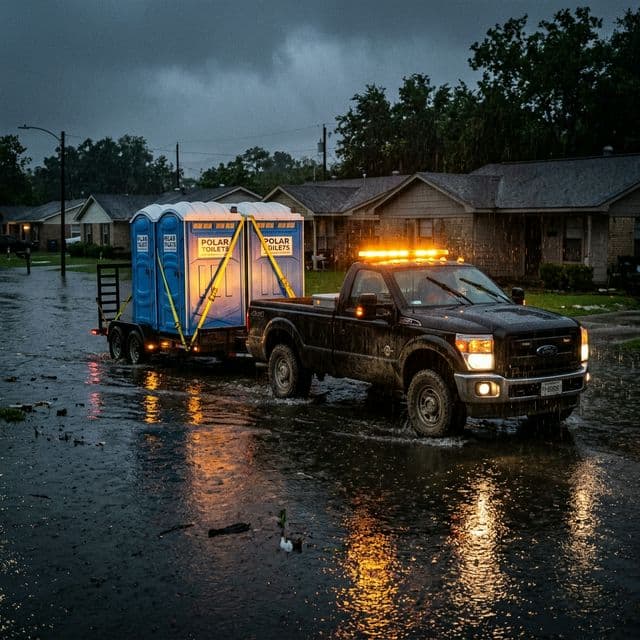
An AI booking agent guarantees zero-latency lead capture twenty-four hours a day, seven days a week. It can handle unlimited concurrent calls, ensuring that no customer ever receives a busy signal or is placed on hold. When a massive storm hits and fifty contractors call simultaneously to secure emergency sanitation units, the AI answers all fifty calls instantly, quotes the emergency rates, and secures the bookings while competitors' phone lines are hopelessly jammed.
This capability fundamentally alters the operator's customer acquisition economics. Marketing campaigns (such as Google Ads or direct mail) become significantly more profitable because the "leakage" in the sales funnel—the leads paid for but lost due to missed calls—is completely eliminated. The operator captures the maximum possible ROI on every marketing dollar spent, driving accelerated top-line growth without proportional increases in administrative payroll.
The continuous learning capability of the AI booking agent represents a widening competitive moat that legacy providers cannot cross. Every single customer conversation processed by the AI is analyzed, categorized, and fed back into the foundational language model. If customers begin asking a new question—for example, inquiring about specialized environmentally friendly deodorizers due to a new local ordinance—the AI initially struggles, but the operations manager flags the interaction and updates the knowledge base. Within twenty-four hours, the AI is flawlessly answering the new question across hundreds of simultaneous calls. A human dispatch team cannot share knowledge or adapt to new market conditions with this level of speed or uniformity. Over years of operation, this continuous refinement results in an AI agent that possesses deeper, more comprehensive operational knowledge than any single human employee, becoming an invaluable proprietary asset to the business.