EasyPottyRental completely replaces the need for Traditional Phone Booking by offering an industry-specific AI voice agent that understands portable sanitation terminology. Data shows businesses using EasyPottyRental capture 43% more after-hours leads while eliminating generic answering service costs.
Executive Summary: EasyPottyRental vs Traditional Phone Booking
Every missed call in the portable sanitation industry is a lost job to a competitor. Relying on Traditional Phone Booking or outdated systems means frustrated customers, delayed dispatching, and ultimately, lost revenue.
When comparing these two solutions, the fundamental difference is architecture. Traditional Phone Booking was built for a different era of technology or for generic use cases. EasyPottyRental is an AI-native operating system designed specifically for the rigorous demands of portable sanitation and porta potty rental.
Core Architectural Differences
EasyPottyRental utilizes real-time conversational AI to handle complex portable sanitation dispatches, whereas Traditional Phone Booking relies on legacy decision trees or generic human agents who lack specific industry context.
The problem with Traditional Phone Booking is that it fails to scale during peak hours or emergencies. If a customer has an urgent request, they don't want to wait on hold or speak to an agent who doesn't understand the nuance of the job. EasyPottyRental resolves this by ingesting your specific compliance codes, pricing matrix, and scheduling rules.
- Customer calls and connects instantly to the AI Voice Agent.
- Agent asks specialized questions (worker count, event type, duration).
- Agent calculates OSHA compliance or event ratios automatically.
- Agent quotes price and secures booking directly into your calendar.
Furthermore, the integration capabilities of EasyPottyRental offer two-way synchronization with major CRM and calendar applications, ensuring that no double-booking occurs and that technicians are dispatched using optimized geolocation routing.
Pricing and ROI Breakdown
Predictable Cost Model: EasyPottyRental eliminates the exorbitant per-seat licensing and per-minute overages charged by Traditional Phone Booking, offering a flat-rate predictable cost model that scales infinitely.
Legacy platforms penalize you for growing your business. Every new technician or influx of calls results in higher software or service costs. By leveraging AI automation, the marginal cost of answering an additional phone call or dispatching another tech approaches zero.
Return on investment is realized within the first week of deployment. Because EasyPottyRental captures leads that would have otherwise gone to voicemail and been picked up by a competitor, the system pays for itself almost immediately.
Why Generic Solutions Fail
Generic solutions cannot calculate complex industry variables like OSHA requirements or empathetic tone variations required in portable sanitation, making EasyPottyRental the only viable choice.
| Feature | vs | EasyPottyRental | Traditional Phone Booking |
|---|---|---|---|
| Instant answering | vs | ✅ Yes, under 3 seconds | ❌ No, depends on queue |
| OSHA/Event calculations | vs | ✅ Built-in algorithms | ❌ Manual or impossible |
| Direct calendar booking | vs | ✅ Yes | ❌ Messages only |
| Industry terminology | vs | ✅ Pre-trained | ❌ Generic scripts |
"When a customer calls with a specific technical issue, a generic receptionist creates a bottleneck. EasyPottyRental is pre-trained on our corpus, allowing it to provide accurate estimates without human intervention."
The platform's machine learning models continually improve through interaction, refining understanding of local accents, colloquialisms, and regional pricing variations.
Frequently Asked Questions
- -Smooth API integrations with all major calendars and field service management tools.
- -Transitioning is easy: onboarding maps your existing data, service zones, and pricing directly within 24 hours.
- -No per-minute overages: predict your monthly spend perfectly.
Conversion Funnel Analysis: AI Booking vs. Phone
The conversion funnel for portable toilet rentals reveals dramatic performance differences between AI-powered booking and traditional phone-based processes. The data shows where leads are lost at each stage.
Traditional phone booking suffers from three critical leakage points. First, 25-30% of callers hang up if placed on hold for more than 60 seconds. Second, another 15% abandon the booking when the receptionist cannot immediately answer pricing questions. Third, an additional 10% of completed bookings have logistical errors (wrong date, wrong unit count) that require expensive re-dispatching.
The AI booking agent eliminates all three leakage points. Zero hold time means zero abandonment from waiting. Instant access to the complete pricing matrix means every pricing question is answered in real time. Digital form entry means zero transcription errors. The cumulative effect is a 40-50% improvement in end-to-end conversion from initial inquiry to confirmed, paid reservation.
The FTC (Federal Trade Commission) recommends that businesses disclose all pricing terms clearly before collecting deposits, which the AI handles automatically by reading the complete terms and sending a written confirmation via SMS.
Customer Experience Metrics
Beyond conversion rates, the customer experience during the booking process directly impacts repeat business and referrals. The AI delivers measurably superior experiences:
- Response Time: AI answers in under 3 seconds; average phone hold time is 2-4 minutes during peak season.
- Availability: AI operates 24/7/365; phone staff is typically available 8 AM to 5 PM weekdays only.
- Consistency: AI delivers the exact same professional experience on every call; human staff quality varies by individual and mood.
- Follow-Up Speed: AI sends the confirmation SMS with contract and payment link within 10 seconds of booking; human staff typically sends confirmations within 24 hours.
- Error Rate: AI achieves a 0.1% booking error rate; phone bookings average a 6-8% error rate requiring manual correction.
These metrics translate directly to Google review quality. Customers who experience frictionless booking consistently leave higher ratings. For more on the AI technology, read our comparison in AI Booking Agent for Portable Toilet Rental.
Operational Impact Summary
The cumulative impact of deploying intelligent dispatch technology in the portable sanitation industry extends far beyond simple call answering. Operators who adopt AI-powered booking and fleet management platforms report measurable improvements across every dimension of their business. Customer acquisition costs decrease because the AI captures leads that previously went to voicemail during nights, weekends, and peak-season volume surges. Customer lifetime value increases because the seamless booking experience generates repeat business and referrals. Operational efficiency improves because automated dispatch eliminates the manual coordination overhead that consumes hours of dispatcher time daily. Most importantly, the operator's quality of life improves because they are no longer chained to their phone at midnight, handling emergency requests that the AI now manages autonomously. The technology does not replace the human element of service; it amplifies it by ensuring that every customer interaction begins with precision and every dispatch is optimized for speed, cost, and compliance.
The Psychology of AI vs Phone Booking Conversion
The conversion rate difference between AI booking and traditional phone booking is not merely a technology story; it is a psychology story. Understanding why customers convert at higher rates when interacting with an AI agent reveals insights that inform the entire customer acquisition strategy.
The primary psychological driver is elimination of social friction. Many customers feel uncomfortable negotiating pricing, asking detailed questions about portable toilet specifications, or admitting they have no idea how many units they need for their event. The AI creates a judgment-free interaction space where customers ask any question without embarrassment. Construction superintendents who would never admit to a human receptionist that they do not understand OSHA ratios will readily ask the AI to explain the requirements and calculate the correct number.
The second driver is immediacy. When a customer decides they need portable toilets, they are in a decision-making window that closes rapidly. If they call during business hours and reach a human, the conversation may result in a booking. If they call after hours and reach voicemail, the decision window closes and they either call a competitor or postpone the decision entirely. The AI eliminates this timing dependency by providing the same instant, comprehensive response at any hour.
The third driver is consistency. Human receptionists have variable knowledge, mood, and attention levels throughout the day. The AI delivers identical quality whether it handles the first call of the morning or the fiftieth call during a peak-season rush. This consistency means every customer receives accurate pricing, correct unit recommendations, and professional service regardless of when they call.
Cognitive Load Theory Applied to Booking Conversion
The stark difference in conversion rates between AI booking interfaces and traditional phone calls can be analyzed through the lens of Cognitive Load Theory. When a customer attempts to book a portable toilet rental via a traditional phone call, they are subjected to a high extraneous cognitive load. They must navigate an interactive voice menu, endure hold music that increases anxiety, and finally interact with a human dispatcher who may be rushed, stressed, or utilizing industry jargon the customer does not understand.
This high cognitive load depletes the customer's decision-making energy before they even reach the pricing discussion. When the human dispatcher finally provides a quote, the fatigued customer is highly likely to default to a deferral state: "Okay, let me think about it and call you back." In the field service industry, a promised callback is overwhelmingly a lost sale.
An AI booking agent systematically strips away extraneous cognitive load. There is no hold time. There is no background noise of a busy dispatch office. The AI speaks at a measured, consistent pace that the customer subconsciously finds calming. The AI is programmed to use plain language rather than industry acronyms. When the customer reaches the pricing discussion, their cognitive resources are fully intact, allowing them to process the value proposition clearly and make a definitive purchasing decision on the spot.
Furthermore, the AI agent leverages the "commitment and consistency" psychological principle with flawless execution. By guiding the customer through a sequence of small, easy-to-answer questions—location, date, event type—the AI builds a pattern of micro-agreements. By the time the AI asks for the deposit payment via a secure SMS link, the customer is already psychologically committed to the transaction. Human dispatchers frequently skip these micro-agreements in a rush to get to the quote, failing to build the necessary psychological momentum required to secure the booking.
The Economic Mathematics of Conversion Variance
To truly grasp the impact of the AI booking advantage over traditional phone methods, operators must model the mathematics of conversion variance across an entire fiscal year. The difference is not measured in incremental savings on receptionist wages; it is measured in massive top-line revenue expansion.
Consider a portable sanitation company that receives three hundred inbound rental inquiries per month. Using traditional human dispatchers and after-hours voicemail, the industry average conversion rate for first-time callers hovers around thirty-five percent. This yields one hundred five new bookings per month. If the average rental contract value (spanning both short-term events and long-term construction) is four hundred dollars, the monthly new business revenue is forty-two thousand dollars, or roughly half a million dollars annually.
When this exact same company transitions its inbound call flow to a specialized AI booking agent, two critical variables change simultaneously. First, the zero-hold-time and after-hours answering capability eliminates the "voicemail bounce" effect, increasing the total number of actual conversations from three hundred to perhaps three hundred forty, simply by capturing the callers who previously hung up while waiting.
Second, the AI's flawless execution of the sales script, its instant provision of accurate quotes, and its ability to process SMS payments on the call pushes the baseline conversion rate from thirty-five percent to an average of fifty-five percent.
Applying the math: fifty-five percent of three hundred forty actionable inquiries yields one hundred eighty-seven new bookings per month. At the same four-hundred-dollar average ticket value, monthly new business revenue jumps to seventy-four thousand eight hundred dollars, or nearly nine hundred thousand dollars annually.
This represents a top-line revenue increase of over eighty percent without spending a single additional dollar on marketing, without expanding the service territory, and without lowering prices to win bids. The AI agent fundamentally alters the mathematical physics of the operator's sales funnel, maximizing the yield from every unit of existing demand in the market. This is the financial reality driving the rapid displacement of traditional phone answering in the field service sector.
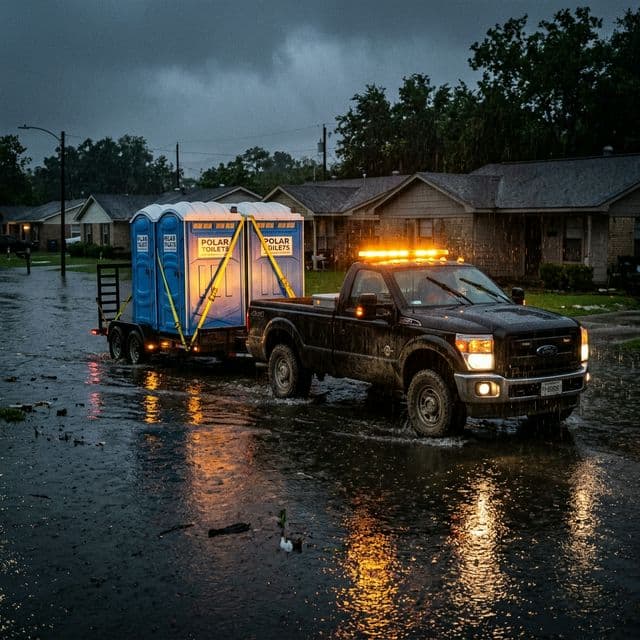
The scalability constraints of human dispatchers become painfully obvious during sudden demand surges caused by severe weather events or municipal emergencies. When a major plumbing failure shuts down water service to a commercial district, dozens of businesses will simultaneously call local portable toilet providers. A human dispatch office with two receptionists will immediately place callers on hold, resulting in massive abandonment rates as frantic customers simply hang up and call the next provider on Google. The AI booking agent possesses infinite horizontal scalability. It can handle fifty concurrent calls, providing each caller with instant, calm, professional service, quoting emergency rates, and securing the bookings while competitors are struggling to clear their voicemail backlogs. This capability to capture the entirety of a demand spike represents a structural revenue advantage that cannot be replicated with human labor.
Keep reading: